
Packaging Selection
PET vs. HDPE for Honey Packaging: An Engineering Guide for Global Bottlers
Compare PET and HDPE honey bottles for clarity, barrier needs, warm filling, squeeze behavior, line performance and export handling before you source.
Written by
Gracepack Honey Packaging Editorial Team
Packaging Content & Product Education. We turn the questions customers ask us about honey bottles, jars, caps, samples, filling and export packing into practical packaging guides.
Technical review by
Gracepack Honey Packaging Project Team
Container, Closure & Packing Review. Our project team checks guidance about model selection, fill-weight references, cap compatibility, samples, carton protection and delivery planning.
Reviewed October 10, 2026. Reviewed against Gracepack's current bottle, closure, sampling, packing, documentation and export-project workflow. Final compliance, filling-process and shelf-life approval remains specific to the selected packaging, honey product and destination market. See our quality and document approach.
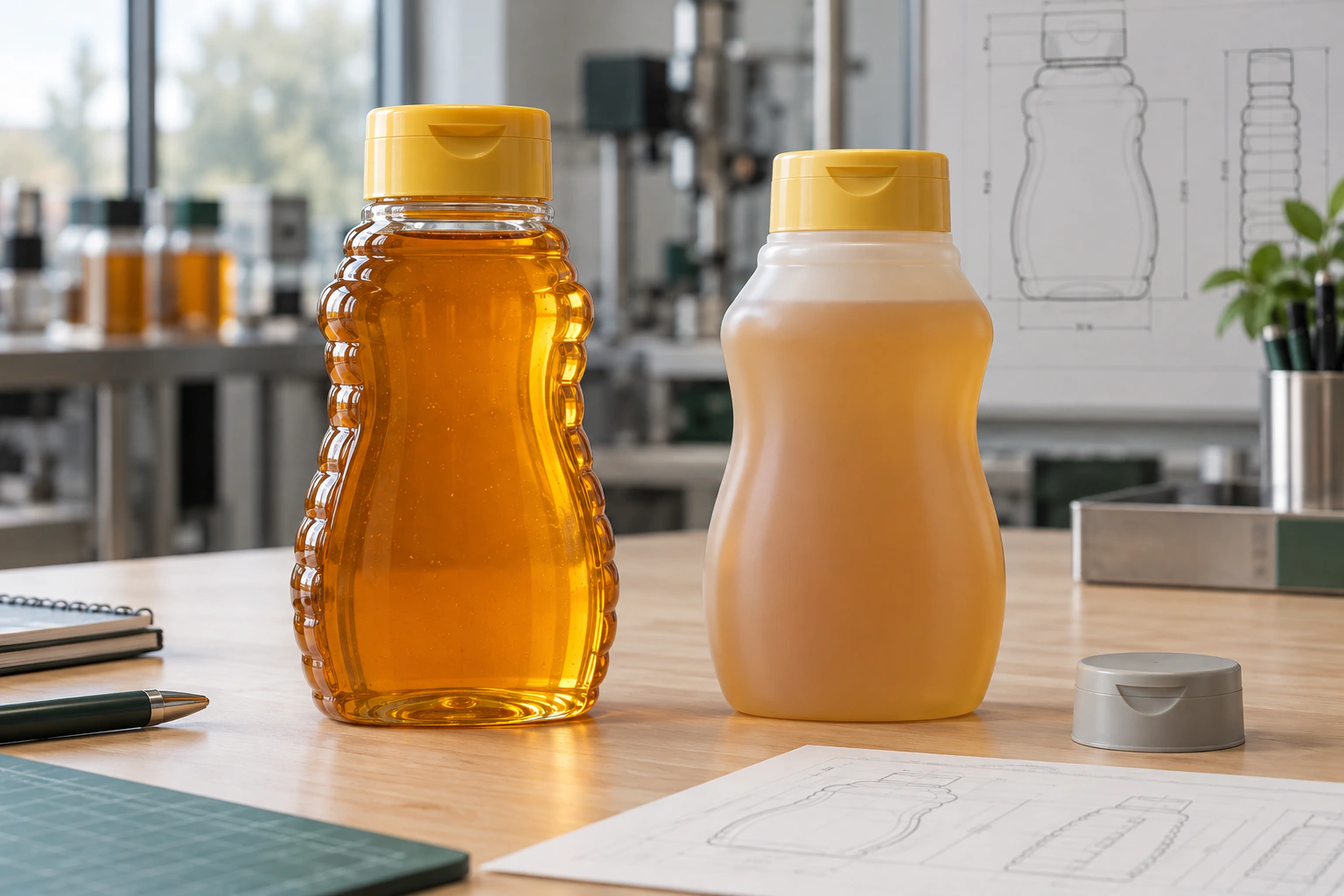
PET and HDPE can both serve honey packaging, but they solve different problems. PET is usually the stronger starting point when shoppers need to see the honey and the pack must feel crisp on shelf. HDPE is worth evaluating when impact toughness, an opaque or translucent presentation, or a more compliant bottle body matters. The resin name alone does not decide the project: bottle geometry, wall distribution, closure, filling temperature, line settings and transport conditions determine whether the finished pack works.
PET vs. HDPE Honey Bottles at a Glance
A useful comparison begins with what buyers and bottling teams will actually notice. PET typically provides a glass-like view of honey color and clarity. HDPE is normally translucent or opaque and feels less rigid at a comparable design intent. Those tendencies influence presentation and dispensing, but they are not performance guarantees.
The table below is a screening tool for a packaging brief. It deliberately avoids universal barrier and temperature numbers because those values change with resin grade, wall thickness, bottle design, test method, temperature and relative humidity. Ask for data tied to the proposed container, then verify the assembled pack.
| Decision factor | PET | HDPE | What the honey bottler should verify |
|---|---|---|---|
| Shelf appearance | Usually clear, glossy and well suited to showing honey color | Usually translucent or opaque; color can be added | Filled appearance under retail lighting, label contrast and scuffing |
| Body response | Typically more rigid and shape-defining | Typically more compliant and impact-tolerant | Grip, squeeze force, recovery and panel deformation with the actual bottle |
| Moisture and oxygen barrier | Often selected where oxygen barrier and product visibility matter | Often selected where moisture barrier is a priority | OTR and WVTR at the same thickness, temperature, humidity and test method |
| Warm filling | Standard bottles can distort if the process exceeds their validated conditions | Grades and designs differ; heat exposure can still affect dimensions | Actual product temperature, dwell time, cooling, fill level and closure application |
| Bottle geometry | Works well for defined retail shapes and lightweight clear bottles | Extrusion blow molding can suit handled and irregular formats | Neck, base, sidewall, handle and conveyor behavior |
| Recycling claim | Resin identification code 1 | Resin identification code 2 | Local collection, color, labels, adhesives, closures and design-for-recycling rules |
| Best first use case | Premium or mainstream retail packs where honey visibility matters | Opaque/translucent packs, impact-focused distribution or large handled formats | Channel, target consumer, line equipment and landed cost |
Start With the Honey and Filling Process, Not the Resin
Honey changes dramatically with variety, moisture content, temperature and degree of crystallization. A pack that dispenses a warm, filtered honey smoothly may frustrate customers when used with a cool, partly crystallized honey. Before choosing PET or HDPE, define the product state at filling and during normal consumer use.
Record the target net weight separately from nominal bottle volume. Honey is sold by weight in many markets, while bottles are commonly described by volume. Density, headspace and fill tolerance mean a 250 ml bottle does not automatically provide a compliant 250 g fill. Establish the fill line with the actual honey and an approved sample.
The international Codex Standard for Honey sets compositional criteria, including moisture limits for honey categories. Packaging does not correct an out-of-spec product, but the pack and seal should help protect the honey from the environment defined in your shelf-life plan.
- Honey type, moisture specification and likely crystallization state.
- Product temperature at the filler, temperature at capping and cooling method.
- Target net weight, intended headspace and allowable fill variation.
- Ambient, refrigerated or climate-controlled storage conditions.
- Upright, side-laid or cap-down distribution and consumer use.
Material Properties and Barrier Integrity: Protecting Honey Quality
Honey is hygroscopic, so moisture control deserves attention, particularly when packs travel through humid supply chains or remain in storage for long periods. Oxygen exposure can also contribute to color and flavor changes over time. PET is often favored for its oxygen-barrier performance; HDPE is often favored for moisture-barrier performance. A closure leak, however, can overwhelm the difference between bottle-wall materials.
Do not compare an OTR value from one supplier with a WVTR value from another and conclude that one bottle has a longer shelf life. OTR and WVTR answer different questions. Results must use a stated specimen thickness, temperature, relative humidity, conditioning procedure and method. ASTM D3985, for example, defines a method for oxygen gas transmission and makes the test conditions part of the result.
For honey packaging material selection, request bottle-level or structure-relevant data when shelf life depends on barrier. Then include the closure, liner or valve in the study. Measure mass change, leakage and product quality at planned checkpoints under the distribution climates that matter to your business.
Closure integrity can dominate the result
A cap that is cross-threaded, under-torqued, distorted by heat or paired with the wrong sealing surface creates a direct pathway for moisture and air. Specify the neck finish, closure, liner or valve, capping method and application target together. Check removal torque and seal performance after conditioning, not only immediately after capping.
Color protection is a separate question
Clear PET exposes the honey to retail light, which is useful for merchandising but may be undesirable for a light-sensitive product or a long display period. An opaque HDPE bottle can reduce light exposure but hides the honey grade and crystallization state from shoppers. If light stability matters, include the intended color, label coverage and shelf lighting in the study rather than relying on resin family alone.
Optical Clarity vs. Squeeze Flexibility
PET earns its place in honey aisles because shoppers can inspect color, clarity and fill level. That visibility supports varietal and premium positioning, and the glossy surface can resemble glass at a lower shipping weight. Browse Gracepack's PET honey bottles to see how bear, ribbed, flat and jar-style geometries change the presentation even within one resin family.
HDPE provides a softer visual language and can tolerate repeated handling well, but an HDPE label panel, shoulder and base need to be engineered for the chosen wall distribution. Consumers do not experience a resin pellet; they experience a bottle. A rigid HDPE design can be harder to squeeze than a well-panelled PET design, and a lightweight PET bottle can crease if its panels are not designed for controlled deflection.
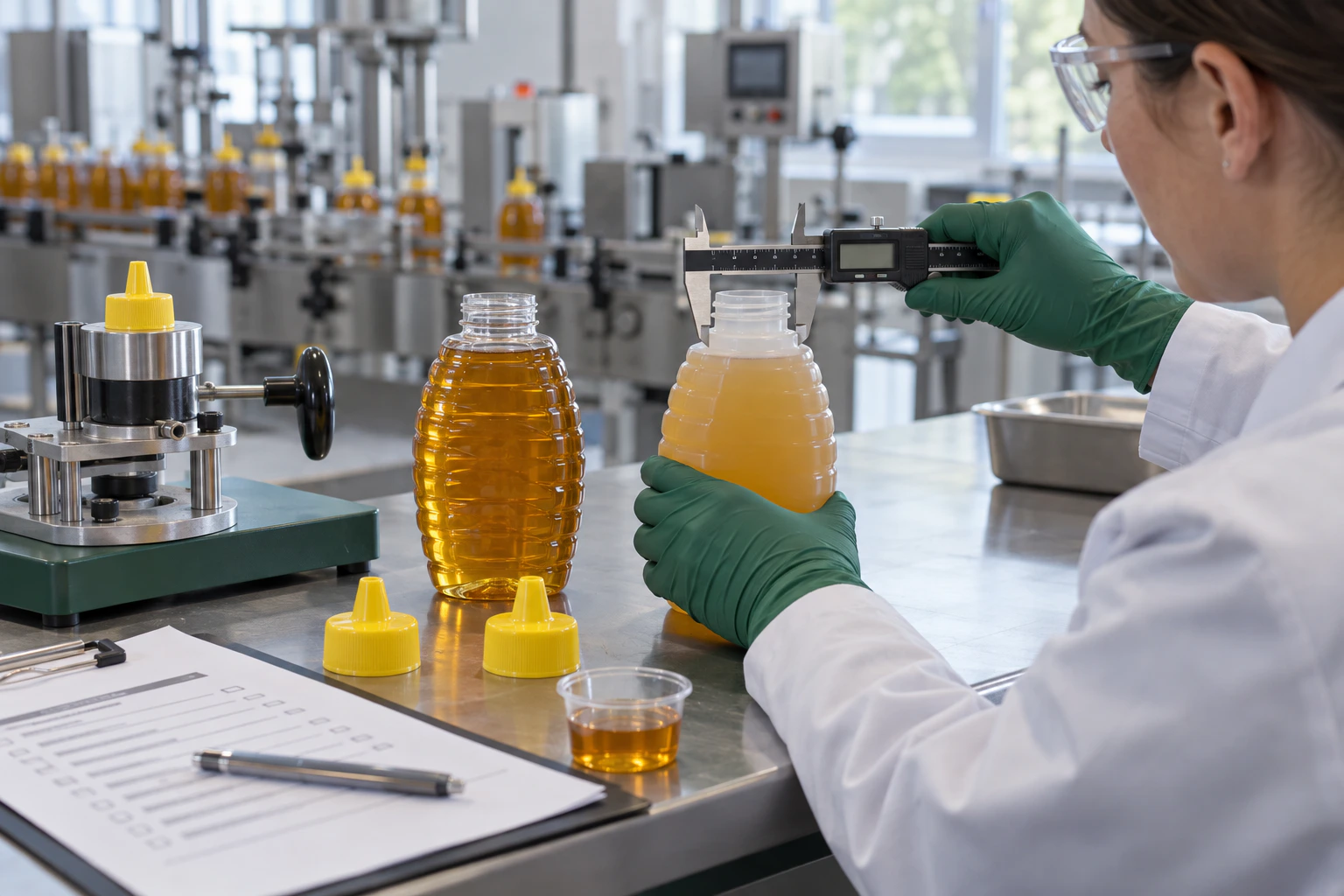
If dispensing is central to the product, compare complete honey squeeze bottles rather than material plaques. Record the peak force needed to start flow, the force needed to maintain it, how quickly the body recovers and whether the package draws air cleanly after release.
Where LDPE fits
LDPE can be relevant when a very soft squeeze response is required, but it should be treated as a third material option with its own documentation and process window. An LDPE migration report does not establish the suitability of PET or HDPE, and a report for one submitted sample does not automatically cover every bottle, color or closure.
The closure controls the last centimetre
Nozzle diameter, valve opening pressure, hinge position and residual honey around the outlet affect cleanliness more than a broad PET-versus-HDPE label suggests. For inverted packs, test standing stability and seepage after warm and cool storage. Gracepack's inverted honey bottle valve caps are evaluated as part of an assembled pack, because valve behavior changes with honey viscosity, outlet geometry and bottle response.
Warm Filling and Dimensional Stability
Many honey bottlers warm product to improve flow, but a process temperature is not the same as a resin's headline heat-resistance value. The container sees a time-temperature history: hot product enters, the sidewall and base absorb heat, the closure is applied, the headspace cools and internal pressure changes. Bottle weight, stretch ratio, geometry and cooling conditions all influence the result.
Standard PET can shrink, panel or lose top-load strength when used outside its validated window. Heat-set PET exists for more demanding processes, but it is a distinct bottle technology and usually changes tooling, appearance, weight and cost. HDPE may tolerate some warm-fill conditions well, yet it can still soften, distort or change sealing behavior. Ask the bottle supplier for the limits of the exact design and grade, then trial the line at the highest expected product temperature and longest credible delay before cooling.
Use production-representative samples. Prototype material, a heavier sample bottle or a hand-applied closure can hide problems that appear on a commercial run. Check brimful capacity, fill line, base rock, neck ovality, paneling, cap seating, leakage and appearance after the filled packs reach room temperature.
Performance on Automated Bottling Lines
A bottle that looks good in a sample room can still create downtime. On an automated line, the package must denest or unscramble, travel between guides, remain stable under the filler and accept a closure at a repeatable height. PET's stiffness can support precise handling, while HDPE's impact resistance can be useful in rougher environments. Either material can fail if the base, centre of gravity or neck geometry does not match the equipment.
Run enough containers to reveal variation. Ten hand-filled samples can confirm basic fit; they cannot establish commercial reject rates. For a pilot run, record line speed, stoppages and reasons for rejection. Photograph recurring defects and retain the bottle, preform or resin lot, closure lot and machine settings used in the trial.
| Line station | PET or HDPE question | Evidence to retain |
|---|---|---|
| Infeed and conveying | Does the bottle remain upright and resist guide-rail scuffing? | Line speed, guide settings, tip or jam count |
| Filling | Does the neck suit the nozzle and does the body hold its shape? | Product temperature, fill accuracy, drips and paneling |
| Capping | Can the cap be applied without neck distortion or thread damage? | Application setting, seating, removal torque and leakage |
| Labelling | Does the panel remain stable and accept the selected label system? | Wrinkles, lift, skew, scan rate and adhesion after conditioning |
| Case packing | Does the pack resist compression and rubbing in the chosen layout? | Carton count, dividers, top load, scuffing and cap contact |
| Inspection | Can cameras and sensors see the fill, label and closure reliably? | False rejects, missed defects and approved reference samples |
Distribution, E-commerce and Export Handling
Impact toughness matters when parcels move through courier networks, but the bottle material is only one layer of protection. A closure can open under side load, a protruding nozzle can crack, and an under-filled carton can allow bottles to accelerate before impact. Test the saleable unit inside the actual carton, insert, tape and pallet pattern.
For export shipments, condition samples for the temperature and humidity extremes expected on the route. Inspect stress whitening, denting, panel recovery, closure leakage, label movement and abrasion. PET may preserve a premium visual impression but make scuffs easier to see; opaque HDPE can hide some visual changes while making fill-level inspection harder.
A transit test should answer a commercial question: will the bottle arrive saleable, seal intact and easy to use? Agree the method and acceptance criteria before the test. A pass on an empty bottle does not represent a filled honey pack because mass, centre of gravity and internal pressure have changed.
Cost, MOQ and Sustainability Without Shortcuts
The cheapest bottle is not necessarily the lowest-cost pack. Compare container, closure, liner or valve, label, decoration, carton, freight, tooling, line changeover and expected rejects. PET and HDPE bottle production use different processes and mold economics, so a custom shape may have different feasibility, cavity strategy and minimum quantity in each material.
Lightweighting can reduce resin and freight, but it can also reduce top load, make panels unstable or narrow the filling window. Set a performance floor first, then reduce weight through controlled trials. The same discipline applies to recycled content: color, odor, process consistency, food-contact status and supply availability need to be reviewed for the destination market and intended use.
Resin identification codes 1 and 2 help identify PET and HDPE; they do not guarantee that a package will be collected or recycled everywhere. Label stock, adhesive, sleeve coverage, color, barriers, closures and local infrastructure all influence the outcome. Use market-specific design-for-recycling guidance and avoid an unqualified '100% recyclable' claim.
A Six-Step Validation Plan for PET and HDPE
Use the same brief and acceptance criteria for both materials. This makes the comparison fair and gives purchasing, quality and operations a record they can use when the project moves from sampling to production.
- 1. Lock the use case: channel, net weight, honey condition, fill temperature, serving temperature, shelf life and destination markets.
- 2. Define the pack: bottle drawing, resin grade, color, closure, liner or valve, label system, carton and pallet arrangement.
- 3. Qualify documents: connect each food-contact declaration or report to the quoted body, closure and use conditions.
- 4. Run filled-pack trials: check fill line, thermal stability, squeeze and recovery, leakage, label behavior and consumer handling.
- 5. Run the line and distribution trial: measure stoppages, capping results, reject reasons and post-transit condition.
- 6. Freeze the approved specification: retain signed samples, drawings, tolerances, test methods, acceptance criteria and change-control requirements.
What to send with an RFQ
- Target honey net weight and the bottle volume range you are considering.
- Filling temperature, holding time and cooling method.
- Preferred clear, translucent or opaque presentation.
- Closure type, outlet or valve requirement, and any existing neck specification.
- Annual forecast, first-order quantity, destination and shipping mode.
- Required food-contact documents, test methods and target market claims.
Decision Matrix: Which Material Fits Your Launch?
Treat this matrix as a shortlist, not an approval. If two options remain credible, run them through the same test plan and compare the cost of achieving the required result. A slightly higher unit price can be justified if it reduces downtime, rejects, leakage or secondary packaging.
| Commercial scenario | Best starting point | Why | Next validation |
|---|---|---|---|
| Premium varietal honey in grocery retail | PET | Clear, glossy presentation lets shoppers evaluate color and fill | Light exposure, label appearance, warm-fill stability and closure seal |
| Everyday squeeze pack for family use | PET or HDPE | Both can work when body panels and closure are engineered together | Squeeze force, recovery, clean cut-off and repeated-use leakage |
| Opaque pack for a long or humid distribution route | HDPE candidate | Moisture barrier and impact resistance may suit the brief | Bottle-level barrier data, seal integrity and transit conditioning |
| Large handled food-service container | HDPE candidate | Extrusion blow molding can support integrated handle geometry | Handle load, drop performance, pouring control and pallet compression |
| Clear inverted retail bottle | PET candidate | Visibility and shape definition support shelf presentation | Valve opening, cap-down leakage, body recovery and base stability |
| Warm process near the limit of a stock bottle | Neither by assumption | Process and bottle must be validated as a system | Maximum-temperature pilot run with production components |
From Material Shortlist to a Production-Ready Sample
Gracepack's listed honey bottle range is PET, including bear, ribbed, flat, inverted and wide-mouth formats. That range gives bottlers several geometries to trial without starting with custom tooling. A 320 ml PET honey bear bottle is one example of a stock-format route where body, closure and label panel can be reviewed together.
The available ISO 22000 certificate covers processing of food-packaging plastic bottles and bottle caps at Cixi Yangen Plastic Industry Co., Ltd. Gracepack also publishes sample-specific PET extractives, BPA and PPWR reports on its quality page. These documents support supplier qualification only within their stated entity, sample, method and scope; they are not blanket certification for every product.
An HDPE request requires a separate availability and specification review because HDPE is not presented as part of Gracepack's listed honey bottle range. Share the material, bottle shape, target fill, closure, quantity and destination so the team can determine whether an existing PET option fits or whether another material route needs separate sourcing or development.
Review your honey bottle material and filling requirements
Send your target honey weight, filling temperature, preferred bottle format, closure, quantity and destination. Gracepack can identify suitable PET options, arrange representative samples and confirm whether another material request requires separate review. The useful outcome of the first conversation is a testable pack specification, not a generic material recommendation.
Honey Packaging FAQs
Is PET or HDPE better for honey bottles?
PET is usually the better starting point when clear shelf presentation and rigid shape definition matter. HDPE is worth evaluating for opaque or translucent packs, impact-focused distribution and some large or handled formats. The final choice depends on the exact bottle, closure, filling process and distribution test.
Can standard PET honey bottles be warm-filled?
Some PET bottles can handle defined warm-fill conditions, but there is no universal safe temperature for every standard PET bottle. Confirm the exact bottle specification and validate product temperature, dwell time, fill level, cooling, capping and post-cool dimensions in a production-representative trial.
Does HDPE always squeeze better than PET?
No. Resin family influences stiffness, but wall thickness, panel geometry, bottle weight and the closure determine the consumer experience. Compare filled samples using the same honey and serving temperature, and measure squeeze force, flow, cut-off and body recovery.
Which material gives honey the longest shelf life?
Shelf life cannot be assigned from PET or HDPE alone. Bottle-wall oxygen and moisture transmission, closure integrity, light exposure, honey composition, fill process and storage conditions all contribute. Use comparable barrier data and a shelf-life protocol for the finished pack.
Can an OTR or WVTR number be used to compare two supplier bottles?
Only when test method, specimen or bottle structure, thickness, temperature, relative humidity and units are comparable. OTR measures oxygen transmission and WVTR measures water-vapor transmission; one cannot substitute for the other.
Does Gracepack manufacture HDPE honey containers?
Gracepack's current listed honey bottle range is PET. An HDPE or LDPE requirement needs a separate availability, documentation and specification review before it can be quoted or approved.
Related Products
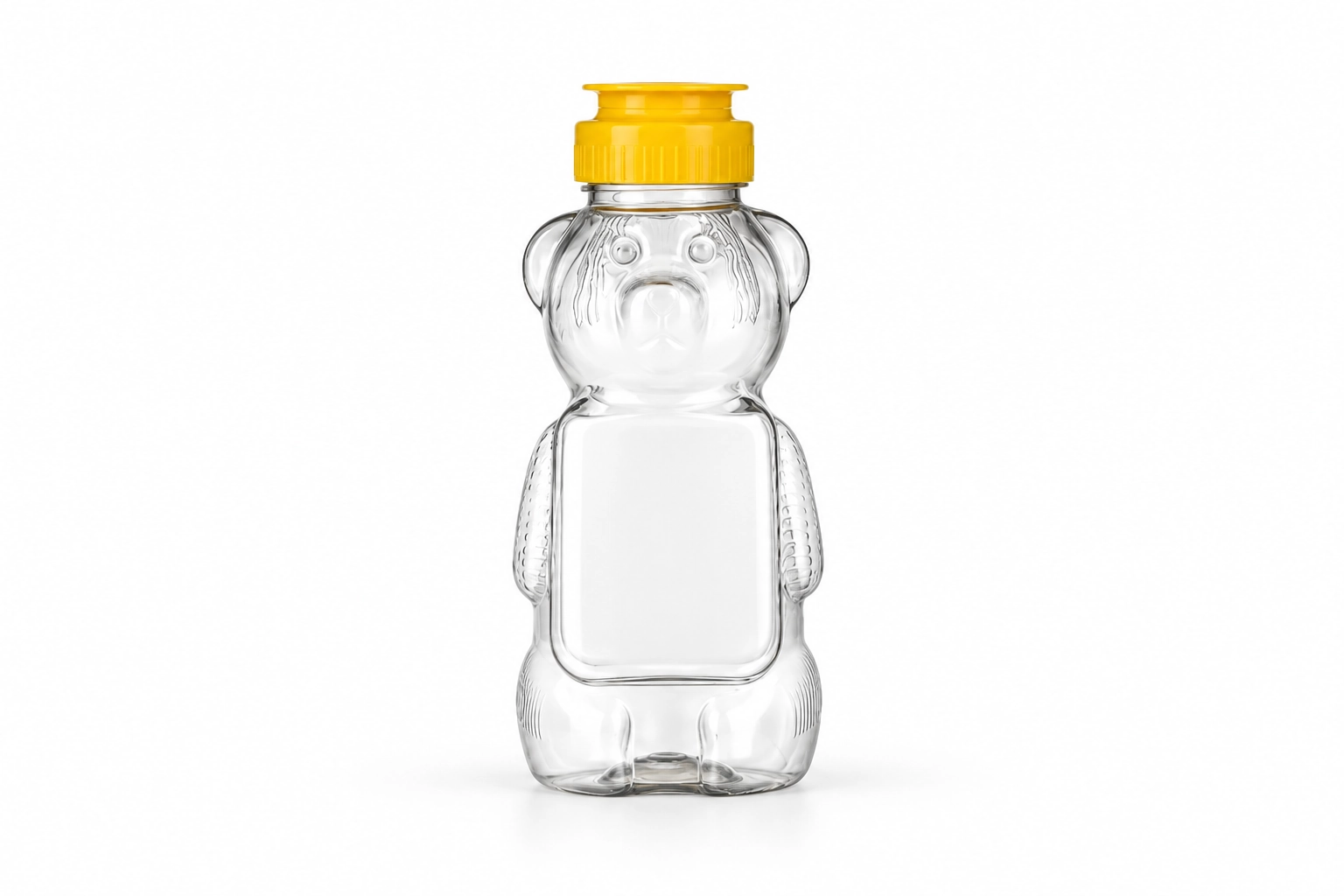
320 ml PET Honey Bear Bottle
Model G-05 is a clear 320 ml PET honey bear bottle with a defined front label panel and matched 38-400 PP flip-top cap.
1 option
View specifications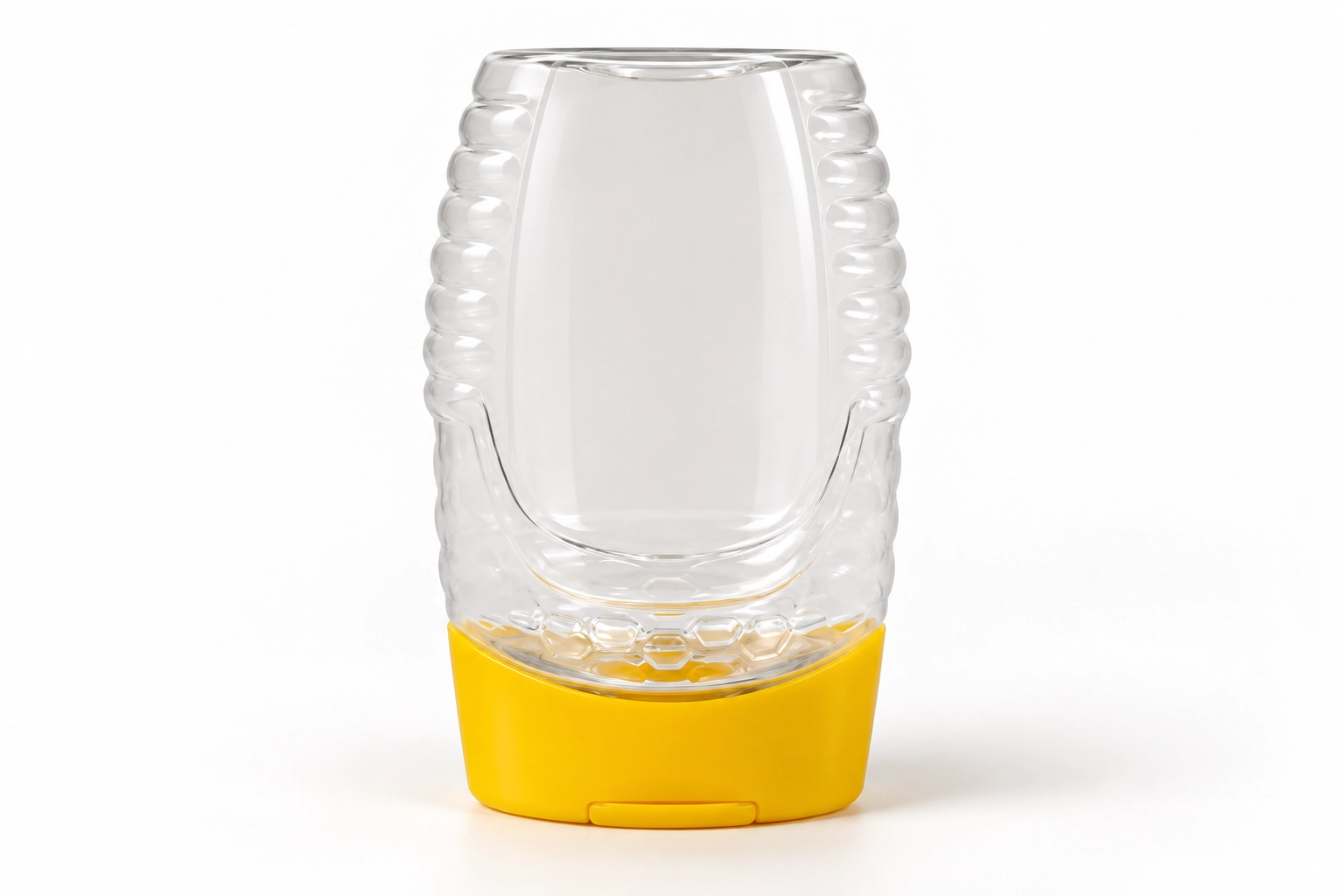
Compact Inverted Honey Bottles
Choose from eight clear PET cap-down honey bottle models in 250–380 ml capacities.
8 options
View specifications
370 ml Wide-Mouth PET Honey Jar
Model AD-5 is a clear 370 ml wide-mouth PET honey jar with a 63-400 neck finish and matched PP screw cap.
1 option
View specifications