
Packaging Selection
How to Choose a Honey Packaging Manufacturer in China for Your Brand
Choose a honey packaging manufacturer in China by checking product fit, food-contact evidence, samples, quality control, MOQ, customization and landed cost.

China offers a broad range of honey bottles, jars and closures, but a large catalog does not automatically make a supplier suitable for your brand. The right partner must understand the finished pack you are trying to create, explain what it manufactures or sources, provide evidence for the proposed materials, and keep the approved specification consistent when you reorder.
Define the Finished Honey Pack Before Comparing Suppliers
A useful supplier search starts with your own packaging brief. Without one, quotations may describe different bottle weights, caps, liners, decoration methods and packing arrangements even when the product photographs look similar. Those quotations cannot be compared fairly.
Write down the target honey net weight, preferred material, bottle or jar style, closure, order quantity, destination market and intended launch date. Add the filling temperature, expected honey condition during filling and the way the pack will be opened and used. If you already have a filling line, include the nozzle size, capping method and any height or diameter limits.
Keep the commercial fill separate from the catalog capacity. A container described as 250 ml does not automatically hold 250 g of honey at the correct fill line. Honey density, headspace, container geometry and filling tolerance all affect the result. Use the catalog capacity to shortlist shapes, then establish the actual net weight with a filled sample.
| Your priority | Packaging direction to examine | What to confirm with samples |
|---|---|---|
| Controlled dispensing | PET squeeze bottle with flip-top, nozzle or valve closure | Squeeze force, outlet flow, reclosure, residue and leakage |
| Spoon access | Wide-mouth PET or glass jar | Opening diameter, fill line, lid seal and label area |
| Recognizable honey shape | Bear or ribbed bottle | Grip, molded detail, label position and cap compatibility |
| Premium presentation | Glass jar with coordinated metal lid | Jar finish, lid fit, breakage protection and carton layout |
| Cap-down convenience | Inverted bottle and compatible valve closure | Standing stability, valve opening, seepage and transport orientation |
| Small portion or gift set | Mini glass or PET jar | Actual fill, artwork legibility, insert fit and outer-box protection |
Describe how the honey will be dispensed
A squeeze bottle needs enough body response for controlled dispensing and enough rigidity to recover after use. The outlet must suit the viscosity of the honey at serving temperature. A jar needs convenient spoon access, a clean sealing surface and a lid system that works with the filling and closing process. An inverted bottle adds standing stability, valve behavior and cap-down leakage to the evaluation.
Packaging that works for liquid honey may be frustrating with a thicker or partly crystallized product. Tell the supplier how the honey behaves instead of asking only for a “standard honey bottle.”
Define the brand presentation
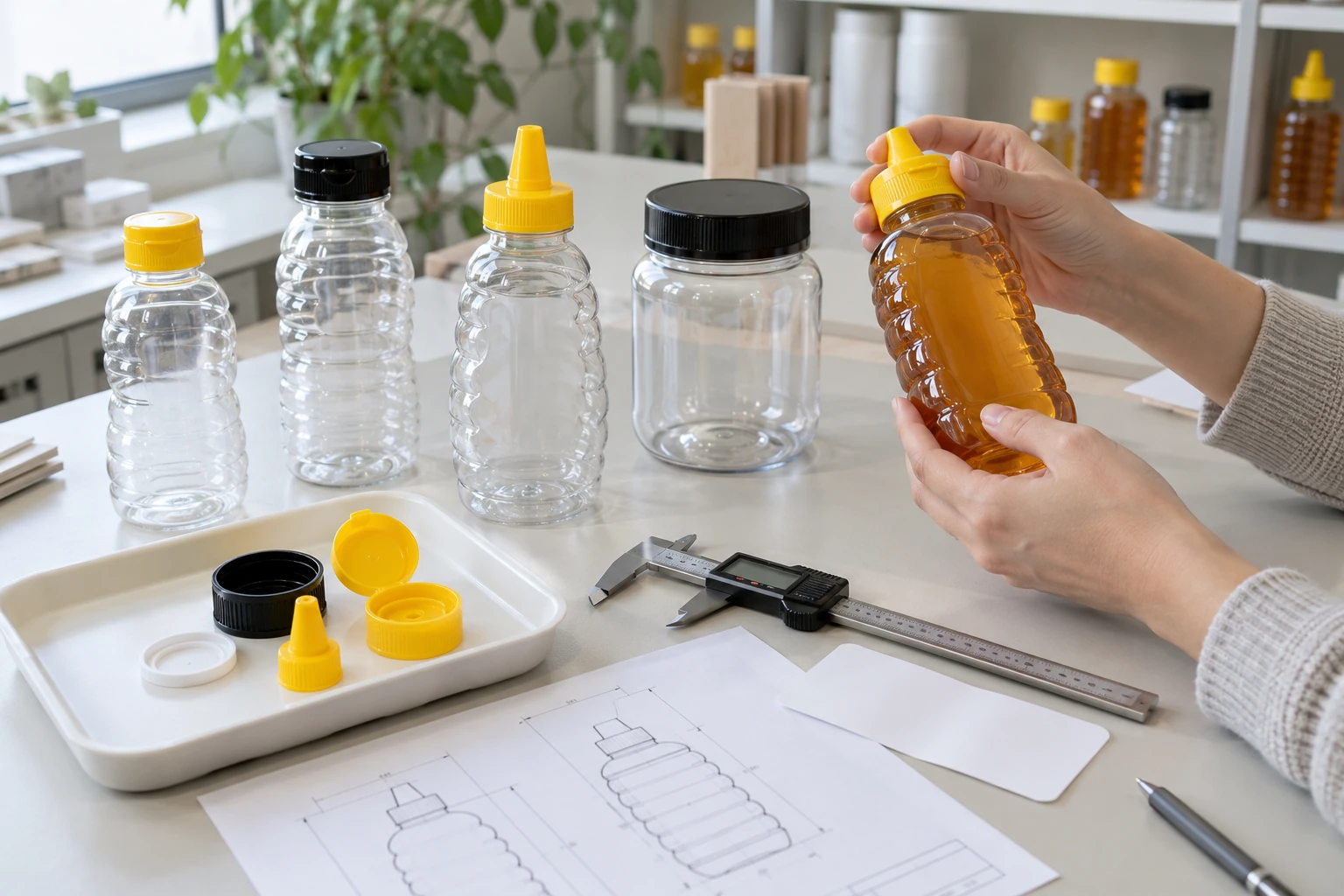
Provide the intended label type, artwork size, cap color and desired shelf appearance. Molded ribs, bear features, shoulders and handle recesses reduce the usable label area. Ask for a dimensioned drawing and place the artwork on a physical sample before approving print dimensions.
Compare formats by their function as well as their appearance. A 320 ml PET honey bear bottle offers a familiar molded presentation, while a 370 ml wide-mouth PET honey jar is designed around spoon access and a broad opening. The correct choice depends on how your honey will be filled, presented and used.
Find Out What the Supplier Actually Controls
The word “manufacturer” can describe several supply models. One company may mold bottles and caps in its own facility, another may manufacture bottles while coordinating sourced closures, and another may assemble a complete range from partner factories. The supply model is less important than knowing who controls each component and who is responsible when parts do not fit.
Ask for the legal company name, factory address and the production scope relevant to your order. Compare this information with the quotation, certificate holder and test-report applicant. If the names differ, ask for a clear explanation of the relationship. A short written answer is more useful than a general claim that every part is made in one factory.
Gracepack is based in Cixi, Ningbo. Its stated ISO 22000 certificate scope covers processing of plastic bottles and caps. Glass jars are coordinated through supply partners. For a project containing both glass and plastic components, the quotation and approved specification need to show which party supplies the jar, lid, liner, decoration and protective packing.
Ask who owns compatibility
A container and closure can come from different molds or facilities and still form a reliable pack, provided one party verifies the complete assembly. Ask who checks the neck finish, thread or lug pattern, sealing surface, cap seating and liner or valve. A supplier that sends a bottle and an unrelated cap without assembly approval transfers the compatibility risk to you.
Look for answers tied to your project
A capable contact will ask about fill weight, honey condition, closure style, artwork, quantity and destination. Precise questions are a positive sign because they lead to a defined specification. Be cautious when every technical request receives an immediate “yes” without a drawing, sample, test condition or production limitation.
Verify Food-Contact Evidence Without Relying on Labels
Food-contact evidence must match the packaging you plan to order. Review the applicant name, submitted sample, material, color if relevant, test standard, test conditions, date and conclusion. A report for a transparent PET sample does not automatically cover every PET bottle, colored masterbatch, PP cap, silicone valve, liner or glass jar in a catalog.
For the United States, the FDA explains that the regulatory status of a food-contact material depends on its individual substances and their authorized conditions of use. That is why a broad phrase such as “FDA certified bottle” is not enough. Ask which regulation, authorization or test applies to the proposed material and whether its conditions correspond to your intended food-contact use.
ISO 22000 is a food safety management-system standard. A valid certificate can support your review of the organization and its controlled scope, but it is not approval of every product. Check the certified legal entity, site, activity scope, issue date, expiry date and certification body. Gracepack’s certificate and available sample-specific reports can be reviewed on the quality documents page.
Match documents to every food-contact component
- Bottle or jar material and any colorant used in the ordered version.
- Cap material, liner, wad, valve or dispensing insert.
- Any coating, ink or decoration that may affect the intended use.
- The filling, storage and temperature conditions relevant to your process.
- The destination market and the documentation requested by your importer or compliance adviser.
Treat BPA and migration reports accurately
A BPA result answers a defined question about a submitted sample and test method. It does not replace a complete material assessment or prove the performance of an assembled pack. Migration or extractives reports also need to be read with their simulants, time, temperature and scope. Ask the supplier to connect each document to the quoted component instead of sending a folder of unrelated certificates.
Test the Complete Pack With Your Honey
Photographs can confirm shape and color, but they cannot confirm dispensing, sealing or line compatibility. Request the bottle or jar together with the proposed production closure. If a liner, valve or tamper-evident feature is part of the order, include it in the sample assembly.
Fill the samples with the honey you plan to sell. Observe the pack immediately after filling and again after storage. Check the fill line, visible paneling, cap seating, leakage, opening effort, reclosure and the amount of honey left around the outlet. Turn squeeze and inverted formats through the orientations they will experience during packing, transport, display and use.
A product such as valve caps for inverted honey bottles cannot be approved from the cap alone. Valve behavior changes with honey viscosity, temperature, outlet geometry, bottle flexibility and the force applied during dispensing.
Run the trial under realistic filling conditions
If your honey is filled warm, tell the supplier the actual product and container temperature. Request the limits for the selected bottle and closure, then check dimensional stability, cap application and leakage under that process. Do not assume every PET, PP or PE container tolerates the same temperature simply because the resin name is familiar.
Confirm that the filling nozzle clears the neck, that the container moves reliably through guides, and that the capping equipment can apply the selected closure. Keep honey away from the sealing surface during the trial so a process problem is not mistaken for a packaging defect.
Check the label and shipping pack at the same time
Apply a full-size artwork proof to the filled container. Review label adhesion, wrinkles, scan position and readability around curves or ribs. Put the closed containers into the proposed dividers, trays and cartons. Glass jars need protection against jar-to-jar contact; plastic packs still need enough support to prevent scuffing, cap damage or deformation.
Record the accepted bottle, closure, artwork and packing arrangement as one approved sample. Photographs help, but they do not replace the physical reference and dimensioned specification.
Choose Between Stock Packaging and Custom Development
Existing molds usually provide the fastest route to samples, filling trials and a first commercial order. You can build a distinct pack through bottle selection, cap color, label shape, printing, sleeves, gift boxes and coordinated sizes before investing in a new container mold.
A 25 ml mini glass honey jar is an example of a format that can be assessed first as a jar-and-lid combination. Once the dimensions and closure are approved, the label, insert and presentation box can be developed around the physical pack.
Choose custom tooling when the required function or recognizable shape cannot be achieved with an existing container. Treat it as an engineering project with defined approval stages, not as a line item added to a bottle quotation.
For a stock format, confirm what can really be customized
- Available bottle or jar material and production color.
- Compatible closure styles, colors, liners and dispensing inserts.
- Label, sleeve, printing or decoration area and setup requirements.
- MOQ for the container, closure color, decoration and carton.
- Current mold availability, sample availability and production lead time.
For a new mold, agree the commercial and technical terms
- Design brief, drawing approval and prototype or trial-sample route.
- Tooling price, payment stages and what revisions are included.
- Mold ownership, exclusivity, storage location and maintenance responsibility.
- Number of cavities, expected output and how later capacity increases will be handled.
- Acceptance criteria for the trial bottle and the process for correcting defects.
- The production MOQ and lead time after the sample is approved.
Separate bottle tooling from cap tooling
A custom cap can require a different mold, development cost and technical risk from the bottle. Before creating a new closure, ask whether an existing compatible neck finish and cap can provide the required dispensing performance. Keeping a proven closure while customizing the bottle can simplify testing and repeat orders.
Compare MOQ, Lead Time and Landed Cost on the Same Basis
A low bottle price can become an expensive project if the closure, decoration or carton has a higher MOQ, or if the quote excludes essential components. Request an itemized quotation that identifies the bottle or jar, cap, liner or valve, color, decoration, inner packing, export carton, tooling, samples, testing and inland transport.
Ask for MOQ by component. The practical first-order quantity may be set by the custom cap color or printed decoration rather than the bottle. Confirm whether excess closures, labels or cartons will be stored, shipped or discarded, and who owns them.
Lead time also needs a starting point. Separate sample preparation, artwork approval, mold manufacture, production, inspection and transport. “Twenty days” can mean twenty days after deposit, after artwork approval, after the cap arrives or after the final sample is signed. Put the trigger and expected completion date in writing.
Build a landed-cost comparison
Compare packaging price, tooling amortization, decoration setup, sample and testing charges, inland logistics, export packing, freight, duty, breakage allowance, inspection and the inventory created by component MOQs. Use the same delivery term and destination for every quotation.
A lighter plastic bottle can reduce freight and breakage exposure. A glass jar may support a different brand position but requires more protective packing. Neither material is automatically cheaper once freight, loss and presentation are included.
Check what happens when something goes wrong
Ask how shortages, visible defects, incompatible closures or transit damage are documented and resolved. The answer needs to cover evidence, timing and responsibility. A clear process before the order is more useful than a promise that problems never occur.
Protect Quality Across Production and Repeat Orders
Once the sample performs correctly, convert it into a production reference. The approved specification needs enough detail for another production run to reproduce the same pack without relying on memory or chat history.
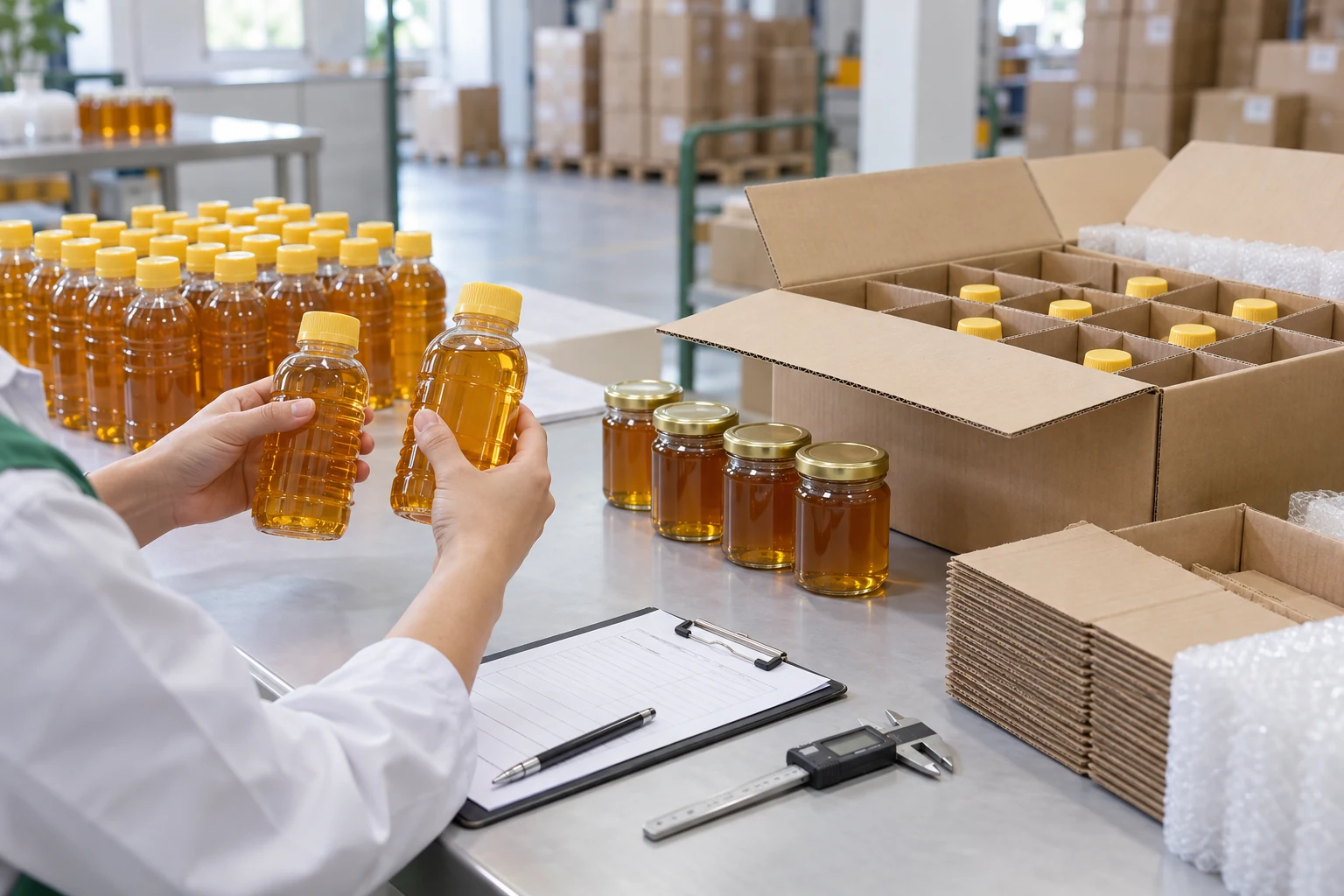
Keep a golden sample with the drawing, component list and artwork proof. Record bottle weight, material, color, critical dimensions, neck finish, cap and liner, decoration, carton count and protective packing. Define which points are critical, which are major visual issues and which variations are acceptable.
Ask how incoming materials, production batches and packed cartons are identified. For repeat orders, require notice before changing resin grade, color masterbatch, cap supplier, liner, mold, decoration process or carton arrangement. Even a small closure change can affect sealing or dispensing.
Agree practical inspection points
- Container appearance, contamination, flash, distortion and visible color variation.
- Critical dimensions, weight and neck or sealing-surface condition.
- Closure seating, opening, reclosure and any liner or valve placement.
- Leakage or dispensing checks defined for the selected assembly.
- Artwork position, print condition, label adhesion and barcode readability.
- Quantity per carton, inner protection, carton markings and pallet condition.
Decide whether you need an audit or pre-shipment inspection
A factory visit or independent audit is useful when custom tooling, order value or compliance risk justifies it. Focus the visit on the processes connected to your pack: incoming materials, mold and component identification, in-process checks, nonconforming product control, packing and traceability.
A pre-shipment inspection can verify quantity, visual quality, packaging and agreed checks before the goods leave China. Define the inspection standard and sampling plan in advance so the result is tied to the purchase specification.
Shortlist the Manufacturer With a Practical Scorecard
After the technical review, compare suppliers using weighted criteria that reflect your project. Product and closure fit, document relevance, sample performance and specification control deserve more weight than presentation quality or catalog size. Price matters after the quotations describe the same complete pack.
A practical scorecard can allocate the highest weight to product fit and sample results, followed by evidence and quality control, commercial terms, communication, lead time and logistics. Add notes beside each score so the final decision can be reviewed by your filling, quality and brand teams.
Send the same final RFQ to every shortlisted supplier. Include your target honey net weight, preferred container, material, closure, liner or valve, filling temperature, label or decoration, annual volume, first-order quantity, destination, compliance market and required date. Ask for the exact sample scope, MOQ by component, tooling terms, lead-time trigger, packing method, delivery term and quotation validity.
For a Gracepack review, share photographs or product links together with your honey and filling details. The team can compare available bottles, jars and closures, define which assembled samples are needed and identify the points that must be confirmed before production.
| Scorecard area | What a strong response contains | What needs clarification |
|---|---|---|
| Product fit | Drawing, component list and explanation tied to your honey and filling process | Only catalog photos or a generic capacity |
| Evidence | Documents mapped to the proposed material, component and use | A certificate folder with no connection to the quoted pack |
| Samples | Assembled samples and a plan for filled-pack approval | Bottle and cap sent separately with no compatibility check |
| Quality control | Golden sample, inspection points, traceability and change notification | “Standard QC” with no agreed acceptance criteria |
| Commercial terms | MOQ and price separated by component, decoration, tooling and packing | One total price with unclear exclusions |
| Delivery | Defined lead-time trigger, packing method and shipping term | An estimated date before artwork and samples are approved |
Common Questions About Sourcing Honey Packaging From China
Is the lowest-priced manufacturer usually the best choice?
No. First confirm that every quotation includes the same bottle weight, closure, liner or valve, decoration and packing. Then compare sample performance, quality controls and landed cost. A small unit-price saving can disappear if incompatible caps, breakage, excess component inventory or rework is added later.
Do I need to visit the factory before ordering?
Not for every stock-container order. A documented company review, relevant reports, video meeting, dimensioned specifications, samples and pre-shipment inspection can provide a practical qualification route. A visit or independent audit becomes more valuable for custom tooling, larger commitments or higher compliance risk.
How many samples do I need?
Order enough assembled packs to check appearance, filling, capping, leakage, dispensing, labels and packing. One display sample is rarely enough for repeated tests. The required quantity depends on your filling trial and the number of closures, colors or materials being compared.
Can one report cover every bottle in a supplier catalog?
Usually not. Read the sample description and scope. Ask the supplier to explain how the report relates to the exact bottle, cap, liner, color and intended use in your quotation. Keep that explanation with the approved specification.
When is a custom honey bottle worth the investment?
Custom tooling is most useful when a distinctive shape, required function or line constraint cannot be met by an existing mold and the expected volume supports the development cost. For an early launch, a proven stock container with coordinated closure and strong artwork often reaches the filling trial faster and with less risk.