
Packaging Selection
Hexagonal PET Plastic Honey Jars: A Lightweight, Breakage-Resistant Alternative to Glass
Compare hexagonal plastic honey jars with glass for clarity, tare weight, breakage risk, closure fit, warm filling and export packaging for wholesale orders.
Written by
Gracepack Honey Packaging Editorial Team
Packaging Content & Product Education. We turn the questions customers ask us about honey bottles, jars, caps, samples, filling and export packing into practical packaging guides.
Technical review by
Gracepack Honey Packaging Project Team
Container, Closure & Packing Review. Our project team checks guidance about model selection, fill-weight references, cap compatibility, samples, carton protection and delivery planning.
Reviewed October 17, 2026. Reviewed against Gracepack's current bottle, closure, sampling, packing, documentation and export-project workflow. Final compliance, filling-process and shelf-life approval remains specific to the selected packaging, honey product and destination market. See our quality and document approach.
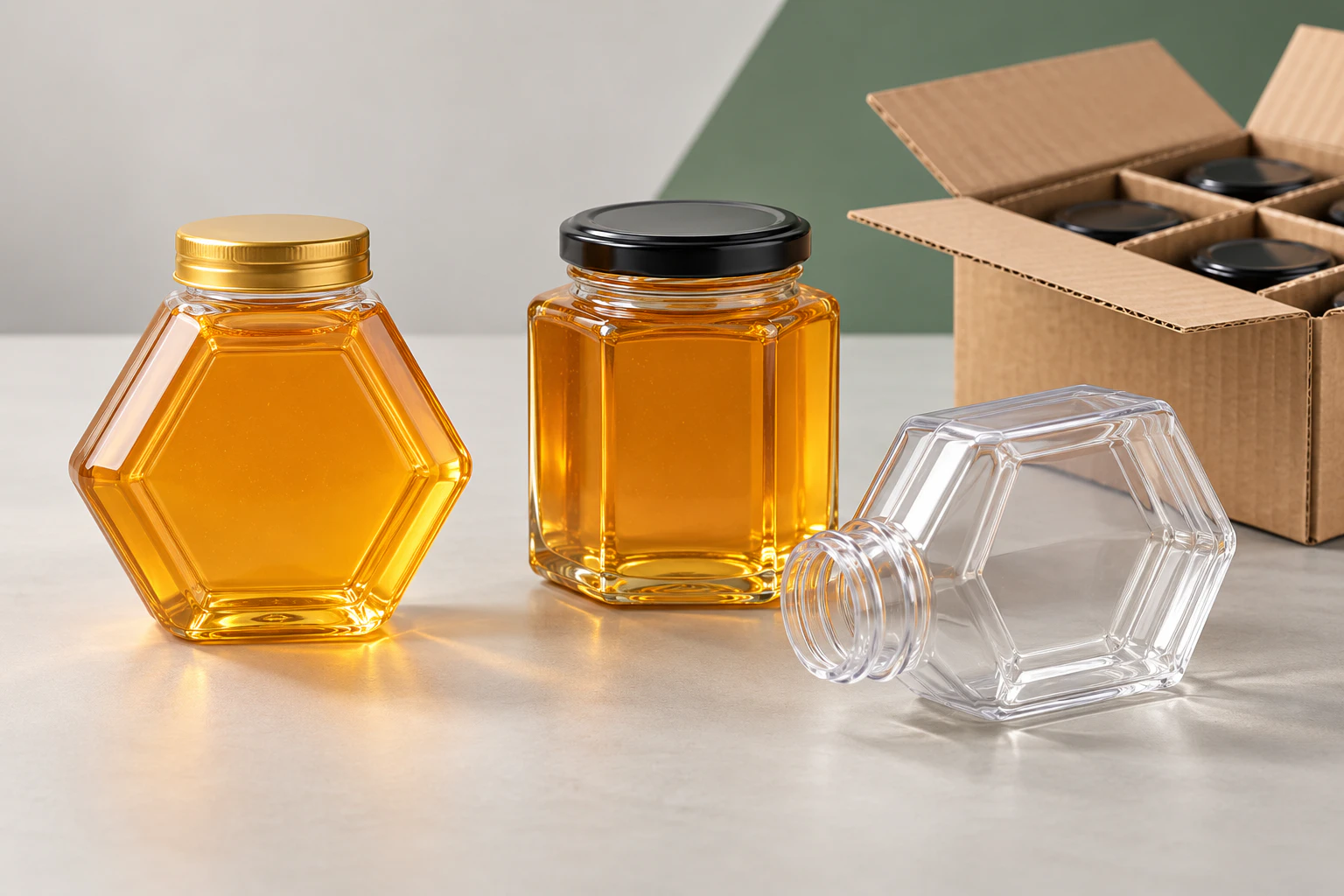
Hexagonal plastic honey jars earn attention before the label is read. Their six-sided outline recalls a honeycomb cell, the flat faces catch light, and clear walls turn the honey itself into the dominant color on shelf. Glass established that premium look, but it also adds tare weight and demands careful protection during parcel and export distribution. Clear PET offers a practical alternative when lower package weight and resistance to everyday impacts matter, provided the chosen jar is approved with the actual honey, closure, filling temperature, label and shipping case.
PET or Glass? A 30-Second Packaging Decision
The choice becomes clearer when the sales channel is defined. PET is often the stronger starting point for an online honey brand, an exporter paying to move empty containers, or a family-size pack likely to be handled around breakfast tables and commercial kitchens. Glass can remain compelling for a premium retail line, a refill program with a controlled washing process, or a pack whose filling conditions are already validated around glass.
Neither material fixes a weak closure, an incorrect fill level or poor secondary packaging. A light PET jar can still leak if the cap and liner do not match its neck. A strong glass jar can still fail if jars strike one another inside an under-specified carton. The useful comparison is therefore between two complete, filled packaging systems rather than two empty containers viewed separately.
| Commercial priority | PET direction | Glass direction | Approval evidence |
|---|---|---|---|
| Parcel and e-commerce delivery | Lower tare and no glass shards after ordinary breakage events | Requires robust separation and cushioning | Filled parcel drop and leak test |
| Premium visual presentation | High clarity with crisp molded facets when the bottle is well made | Traditional weight, gloss and perceived permanence | Shelf sample with final honey and label |
| Warm filling | Bottle-specific time and temperature limit must be confirmed | Often offers a wider thermal processing window | Production-temperature filling trial |
| Reducing empty-pack freight | Usually favorable, but calculate the actual assembly | Higher container tare | Measured jar, closure, carton and pallet weights |
| Reuse or repeated hot washing | Only where the exact pack and process are designed for it | May be more suitable under a defined reuse system | Wash-cycle and closure-replacement protocol |
Hexagon Geometry: From Honeycomb Recognition to Shelf Performance
The hexagon is unusually efficient visual shorthand for honey. Shoppers connect six-sided geometry with honeycomb even when the pack carries no bee illustration. That association can help a single-origin or apiary brand communicate provenance with restrained graphics, while the facets create alternating highlights and shadows that make amber, golden and dark varietals look dimensional under retail lighting.
The same geometry has engineering consequences. A hexagonal body provides broad front and back faces for a product label, but the usable panel ends before each corner. A label that bridges two facets must bend over an abrupt change in plane. Its edge can lift, fine print can distort, and a barcode can become harder to scan. Measure the truly flat area on a physical sample, keep the artwork inside that boundary, and leave a margin around the shoulder, base radius and parting line.
Panel depth also affects presentation. A shallow recessed panel can protect a pressure-sensitive label from rubbing against adjacent jars, yet an excessive recess can create uneven material distribution or make the label difficult to wipe down. On a squeeze format, the center panel must not buckle so sharply that it creases the label. On a rigid jar, facets and corners should remain visually even after filling, capping and normal case compression.
Case packing deserves equal attention. Six-sided packs do not automatically tessellate efficiently once circular caps, shoulders, labels and clearance are included. Establish the bottle orientation inside the carton, measure the maximum body width rather than one flat face, and decide whether bottles need dividers or surface protection. A stable orientation also helps a labeler, vision system or operator present the same panel consistently.
PET vs. Glass: What Changes Beyond Appearance
Good clear PET can produce sharp corners, strong light transmission and a convincing premium effect, especially after the jar is filled with clean honey. It remains a polymer package, however. Wall thickness, preform selection, blowing conditions and mold polish influence how closely the surface approaches glass. Scuffing during high-volume transport can reduce brilliance, so bottle bags, layer pads and carton orientation may matter for an unlabelled or minimally labelled pack.
Glass brings stiffness, traditional weight and strong resistance to gas and moisture transmission through the container wall. PET reduces tare and handles routine knocks without creating broken glass, but its wall, neck and base still require validation. A dropped PET jar may survive without splitting yet suffer a distorted closure, stress whitening or a slow seal leak. Material selection should be based on the failure mode that matters to the brand, not on one headline property.
| Attribute | Clear PET hexagonal pack | Hexagonal glass pack | What to verify |
|---|---|---|---|
| Empty-pack weight | Usually substantially lower | Higher | Weigh the jar, cap and liner together |
| Impact behavior | Resists many routine drops without glass fragments | Can chip or shatter | Test the filled retail and shipping pack |
| Clarity | High clarity; mold finish and scuff protection affect appearance | Classic brilliance and rigid facets | Review filled samples under shelf lighting |
| Thermal window | Depends on resin, design, wall distribution, dwell time and process | Generally more tolerant of elevated process temperatures | Run the intended filling and cooling cycle |
| Barrier | Requires pack-level shelf-life review | Strong wall barrier | Include the closure, liner and storage conditions |
| Surface handling | Can scuff or scratch in transit | Can scratch but is more vulnerable to chips and impacts | Approve carton packing and label protection |
| End-of-life claim | PET has established recycling pathways in many markets | Glass has established recycling pathways in many markets | Check local collection, color, label, adhesive and closure rules |
Freight Economics: Calculate the Saving Instead of Assuming 80%
A dramatic percentage is easy to publish and difficult to defend. The defensible number comes from weighing comparable assemblies. Include the jar, cap, liner or seal, labels, dividers, bags, carton, pallet contribution and any extra protection required by the chosen material. Use the same target honey net weight and the same destination for both options.
Calculate empty-container tare reduction as: (glass assembly weight − PET assembly weight) ÷ glass assembly weight × 100. Then calculate the shipment again after filling. Honey is dense, so the container represents a smaller share of a filled pack than it does in an inbound shipment of empties. The percentage saving on filled export cases will therefore normally be lower than the percentage difference between empty jars.
Model-specific arithmetic prevents false savings claims. Gracepack's AD-5 370 ml wide-mouth PET honey jar has a 35.5 g body and a 7.5 g cap, with a reference honey fill of about 500 g. Gracepack's three hexagonal glass formats have glass body weights of 89.5 g, 103 g and 147.5 g, but they also have different capacities and reference fills. Dividing one of those glass weights by the AD-5 weight would create a misleading comparison because the geometry and fill targets do not match.
The purchasing calculation should also include cube. A lighter container does not guarantee better freight economics if a wide body or inefficient carton reduces units per pallet or container. Compare cases per pallet, pallet height, container utilization, gross weight limits and protective packing. Add a realistic allowance for breakage, leakage, repacking and customer replacement. That total landed-cost view can justify PET even when the unit price alone does not.
| Cost input | How to measure it | Why it changes the result |
|---|---|---|
| Primary-pack tare | Weigh the approved jar, closure, liner and label | Defines the direct material weight difference |
| Case materials | Record carton, partitions, bags and pads per case | Glass may require more separation; PET may need scuff protection |
| Pack density | Calculate units per case, pallet and container | Volume can become the freight constraint before weight |
| Distribution loss | Track damage, leaks, replacements and labor | A small damage-rate change can outweigh a unit-price difference |
| Filled-pack mass | Add actual declared honey weight and process tolerance | Honey reduces the relative impact of container tare |
Transit Security: Validate the Filled Pack, Not Just the Empty Jar
The word shatterproof is useful shorthand, but no package is immune to distribution damage. PET removes the specific hazard of shattered glass in many impact events, yet a package can still fail through a cracked corner, deformed neck, loosened closure, punctured sidewall or leaking liner. Testing must use the production-intent bottle, cap, seal, label, honey fill and shipping case.
Begin with dimensional and visual inspection, then fill to the intended net weight and headspace. Apply the production torque or closing process. Hold samples upright, on their sides and inverted at the planned storage temperatures. Inspect the neck, sealing land and label after conditioning. A clean exterior immediately after capping does not prove that a slow leak will not appear several days later.
Distribution testing should reflect the route. Parcel networks expose an individual pack to repeated drops and mixed orientations. Palletized export shipments add vibration, sustained compression, humidity and handling transitions. ASTM D5276 describes free-fall drop testing for loaded containers, while broader programs may combine drop, vibration and compression procedures. The applicable sequence and acceptance criteria need to be chosen for the package and channel rather than copied from an unrelated product.
Define success before the trial: no leakage, no closure release, no unreadable label, no unacceptable panel distortion and no carton failure that compromises saleable product. Photograph and retain samples from each orientation. If failures occur, adjust the bottle, closure torque, liner, divider or carton and repeat the complete sequence.
Wide-Mouth Closures: 58 mm, 63 mm and 70 mm Are Only Starting Points
A nominal diameter helps narrow a search, but it does not define a closure system. Two openings described as 63 mm can use different threads, starts, heights, sealing lands or lug patterns. A continuous-thread cap will not become compatible with a lug finish because the stated diameter looks similar. Match the complete neck finish and approve the assembled cap, liner and jar from the same specification.
The actual inside opening is equally important. Liquid honey can pass through a smaller opening than creamed honey, partly crystallized honey or chunk comb. A wooden dipper or serving spoon needs clearance through the inner bore, not merely under the cap. Broad shoulders can also trap product even when the mouth is wide. Test filling and serving with the real honey condition expected at the coldest normal temperature.
Closure choice affects both premium presentation and protection. Smooth gold or black caps can support a glass-inspired look; ribbed PP caps improve opening grip. A liner or induction-seal structure must match the container material, sealing surface and process. Tamper evidence, opening torque and liner removal all need to work for the intended user. Diameter alone cannot answer any of those questions.
Gracepack's AD-5 wide-mouth PET jar uses a 63-400 finish with a matched PP cap. The 360 ml hexagonal PET honey squeeze bottle uses a different 41-410 finish and pointed PP dispensing closure. The hexagonal body does not make these two packs interchangeable; each serves a different filling and dispensing brief.
Warm Filling, Headspace and Honey Net Weight
A jar's catalog volume is commonly a water-capacity reference. It is not the declared honey net weight. Honey is heavier than water, and its density changes with moisture content and temperature. Shoulder geometry, fill line, closure displacement and line tolerance also affect how much product can be sold in a given container. Establish the declared net weight on filled samples rather than converting directly from a nominal milliliter value.
Warm honey flows more easily and can reduce filling time, but a convenient process temperature may be too demanding for a particular PET design. There is no universal safe temperature for every standard PET jar. Resin, preform, wall distribution, neck geometry, exposure time, fill level, cooling and capping all contribute. Ask for the conditions supported by the selected container, then run a trial at the highest credible product temperature and longest credible dwell time.
Inspect samples after filling, after cooling and again after storage. Look for sidewall paneling, base movement, neck ovality, cap lean, seal disturbance and label wrinkling. Headspace must accommodate process variation without pushing honey into the sealing land during capping. It must also preserve the intended shelf appearance: an excessive gap can look underfilled even when the net weight is correct.
For the United States, declared net weight is commonly planned in ounces and pounds alongside metric units; many Australian and European programs begin with grams. A 500 g brief and a one-pound brief are not identical. Build the mold shortlist around the intended market declaration, honey condition and fill line, then confirm it with calibrated filling equipment.
Food-Contact and Recycling Claims Need a Defined Scope
A statement such as FDA approved jar is too broad to qualify a finished pack. The US FDA distinguishes the food-contact substance, the material made from those substances and the finished food-contact article. It also ties authorizations to intended conditions of use. The FDA guidance on determining food-contact status explains why every substance expected to migrate from the material must have an appropriate regulatory basis.
Gracepack has PET migration, extractives and BPA-related reports as well as an ISO 22000 certificate covering the stated processing scope for food-packaging plastic bottles and caps at Cixi Yangen Plastic Industry Co., Ltd. These are useful qualification documents when their applicant, sample description, test method and intended use match the proposed pack. They are not blanket approval for every jar, color, cap or market. Request the documents mapped to the quoted components and read their scope before making a claim.
PET also has established recycling routes in many markets, but recyclability is a package and location question. Clear material is generally easier to place in existing PET streams than dark or opaque decoration, yet labels, adhesives, sleeves, metal components, closures and local collection rules still affect the outcome. Use a market-specific claim that the finished pack can support.
Choosing Between a Stock Pack and a Custom Hexagonal Mold
A stock format is usually the fastest route to a filling trial. It lets a brand validate declared weight, shelf presence, closure performance and consumer handling before funding new tooling. A familiar container can still look proprietary through disciplined label architecture, cap color, tamper evidence and an outer carton designed around the brand.
Custom tooling becomes more rational when a repeatable commercial requirement cannot be met by an existing mold. That requirement might be a larger uninterrupted label panel, a more efficient case footprint, a proprietary honeycomb texture, a defined grip zone, an unusual net weight or dimensional limits imposed by an established filling line. Expected volume must support drawing, tooling, sampling, pilot production, qualification and future mold maintenance.
Begin a custom project with measurable inputs: target honey net weight, brimful and usable capacity, fill temperature, neck finish, cap and liner, maximum dimensions, label-safe area, bottle weight target, top load, distribution route and annual demand. Approve the drawing before cutting steel, then inspect pilot samples against the drawing and the agreed golden sample. A distinctive rendering is not a production specification.
| Choose a stock pack when | Consider custom tooling when |
|---|---|
| The launch schedule is short | A required function cannot be achieved with a current mold |
| Demand is still being validated | Forecast volume can absorb development and qualification costs |
| Labels and closures can create sufficient differentiation | A proprietary silhouette or panel is commercially important |
| Existing dimensions fit the line and case | Line handling or pallet efficiency requires new geometry |
Build a Production-Ready Hexagonal Honey Pack with Gracepack
Gracepack offers clear PET and glass formats that can be compared with the same honey, artwork and handling conditions. Model A66 is a flat 360 ml PET hexagonal squeeze bottle with a reference honey fill of about 500 g, a 41-410 neck and a pointed PP dispensing cap. Its broad front and back faces support separate branding and information labels, while the label outline must allow for the sloping shoulders. Model AD-5 is a 370 ml clear wide-mouth PET jar with a reference honey fill of about 500 g and a 63-400 finish for a matched PP cap.
For brands that want the traditional material as a benchmark, Gracepack's hexagonal glass honey jar series includes small faceted formats with model-specific dimensions and lids. Comparing these samples alongside a PET candidate makes the trade-offs visible: empty weight, filled handling, facet definition, label fit, protection requirements and shelf character can all be reviewed with the same honey and artwork.
The useful first step is a clear packaging brief. Send the target honey net weight, highest filling temperature, honey condition, preferred dispensing method, label dimensions, destination market, distribution channel and estimated annual quantity. Gracepack can then identify a relevant stock format or assess whether a custom mold has a sound technical and commercial basis.
The approval sequence should move from brief to drawing, assembled samples, filled-product trial, closure and seal checks, label proof, case packing and distribution testing. Pricing becomes more meaningful after the component set, decoration and packing method are defined. That sequence reduces the chance that a visually attractive jar reaches production before its fill, cap or shipping case is ready.
Hexagonal PET Honey Jar FAQs
Are clear PET hexagonal honey jars as clear as glass?
High-quality clear PET can provide strong transparency and crisp faceted reflections, especially when filled with honey. It does not duplicate every glass characteristic. Mold polish, material distribution, scuffing, wall thickness and packing protection affect the final appearance, so compare filled and labelled samples under realistic shelf lighting.
Can PET honey jars be used for warm-filled honey?
Only after the exact jar and process are validated. PET designs do not share one universal temperature limit. Confirm the supported conditions for the selected container and test the highest expected honey temperature, dwell time, fill level, cooling process, capping and post-cool dimensions.
Does a 500 ml jar hold 500 g of honey?
No. Milliliters describe volume and grams describe mass. Honey is denser than water, and the saleable fill also depends on moisture, temperature, headspace, shoulder geometry and filling tolerance. Establish the declared net weight with the actual honey and a calibrated filling trial.
Are PET honey jars completely shatterproof?
PET avoids the glass-fragment failure associated with a shattered glass jar and resists many routine impacts, but it is not immune to damage. A severe drop can deform the neck, crack a corner, loosen a cap or create a slow leak. Test the complete filled package and shipping case.
Which opening is suitable for creamed or chunk honey?
Choose from the actual inside opening and shoulder geometry, not the nominal cap diameter alone. The mouth must admit the filling nozzle, serving spoon, dipper or comb pieces at the coldest expected product condition. A filled handling trial is the most reliable confirmation.
Will every 63 mm lid fit a 63 mm PET jar?
No. Nominal diameter does not define the thread, lug pattern, finish height, sealing land or liner. Match the complete neck-finish specification and approve the jar, cap and liner as one assembled system.
How should freight savings against glass be calculated?
Weigh comparable jar-and-closure assemblies, then add labels, dividers, bags, cartons and pallet contribution. Compare units per case and pallet as well as total mass. Recalculate after adding the actual honey fill, and include expected damage, repacking and replacement costs.
Are clear PET honey jars recyclable?
PET has established recycling pathways in many markets, but acceptance depends on local collection and the finished package. Color, labels, adhesives, sleeves, closures and residual product can affect sorting and recovery. Confirm the claim for the destination market.
Should a label wrap across the corners of a hexagonal jar?
A pressure-sensitive label normally performs more predictably when it stays within one flat panel. Crossing a corner can distort graphics, reduce barcode readability and encourage edge lift. Measure the label-safe area on the physical jar and test production-intent stock and adhesive.
What information is needed for a reliable quotation?
Provide the target honey net weight, filling temperature, honey condition, preferred jar and closure style, liner or tamper-evidence requirement, label dimensions, quantity, destination and distribution channel. Add filling-line limits and carton requirements when they are known.
Related Products
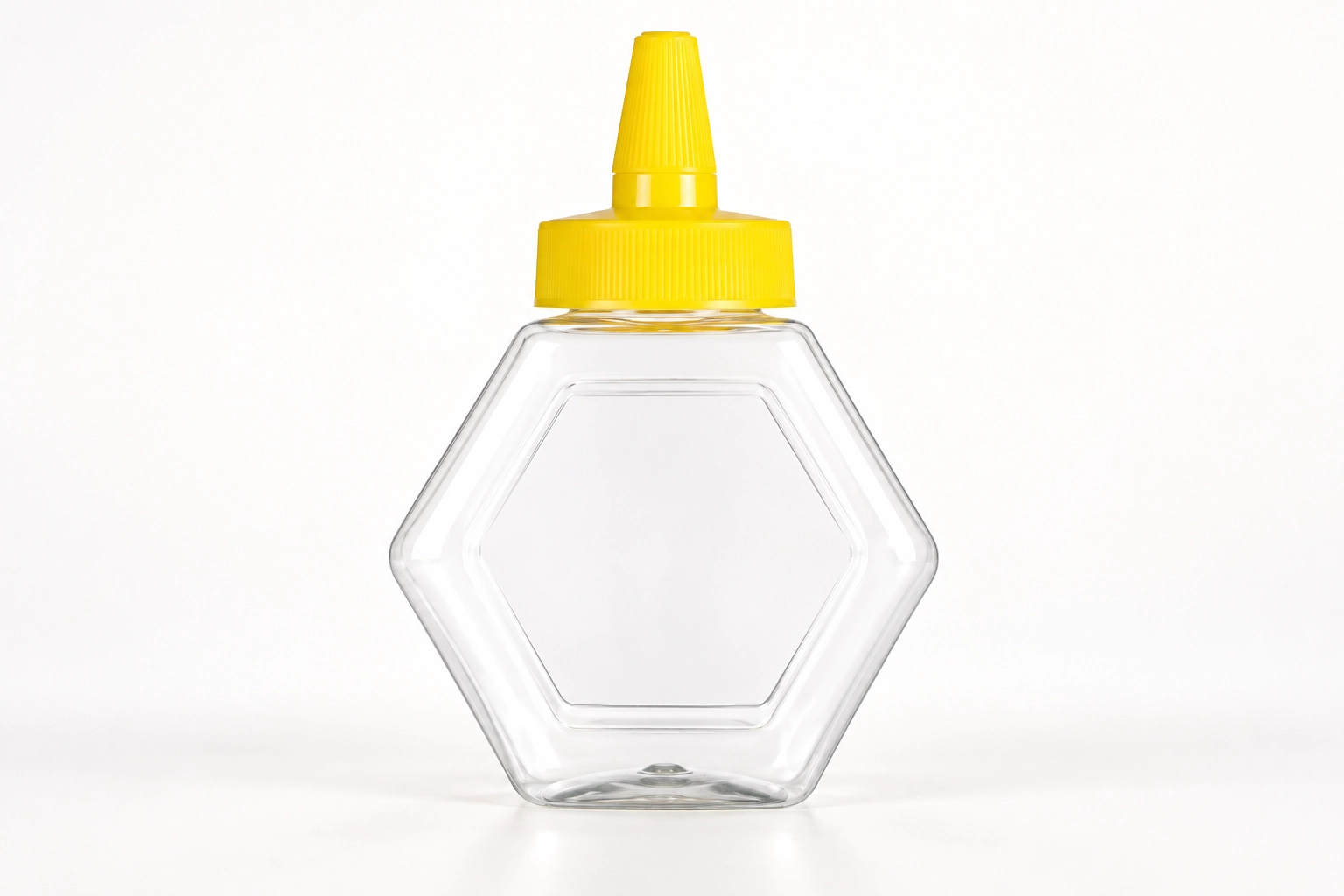
360 ml Hexagon Honey Squeeze Bottle
Model A66 is a clear 360 ml PET honey squeeze bottle with a faceted six-sided body, broad front and back label faces and a matched 41-410 pointed PP dispensing cap.
1 option
View specifications
370 ml Wide-Mouth PET Honey Jar
Model AD-5 is a clear 370 ml wide-mouth PET honey jar with a 63-400 neck finish and matched PP screw cap.
1 option
View specifications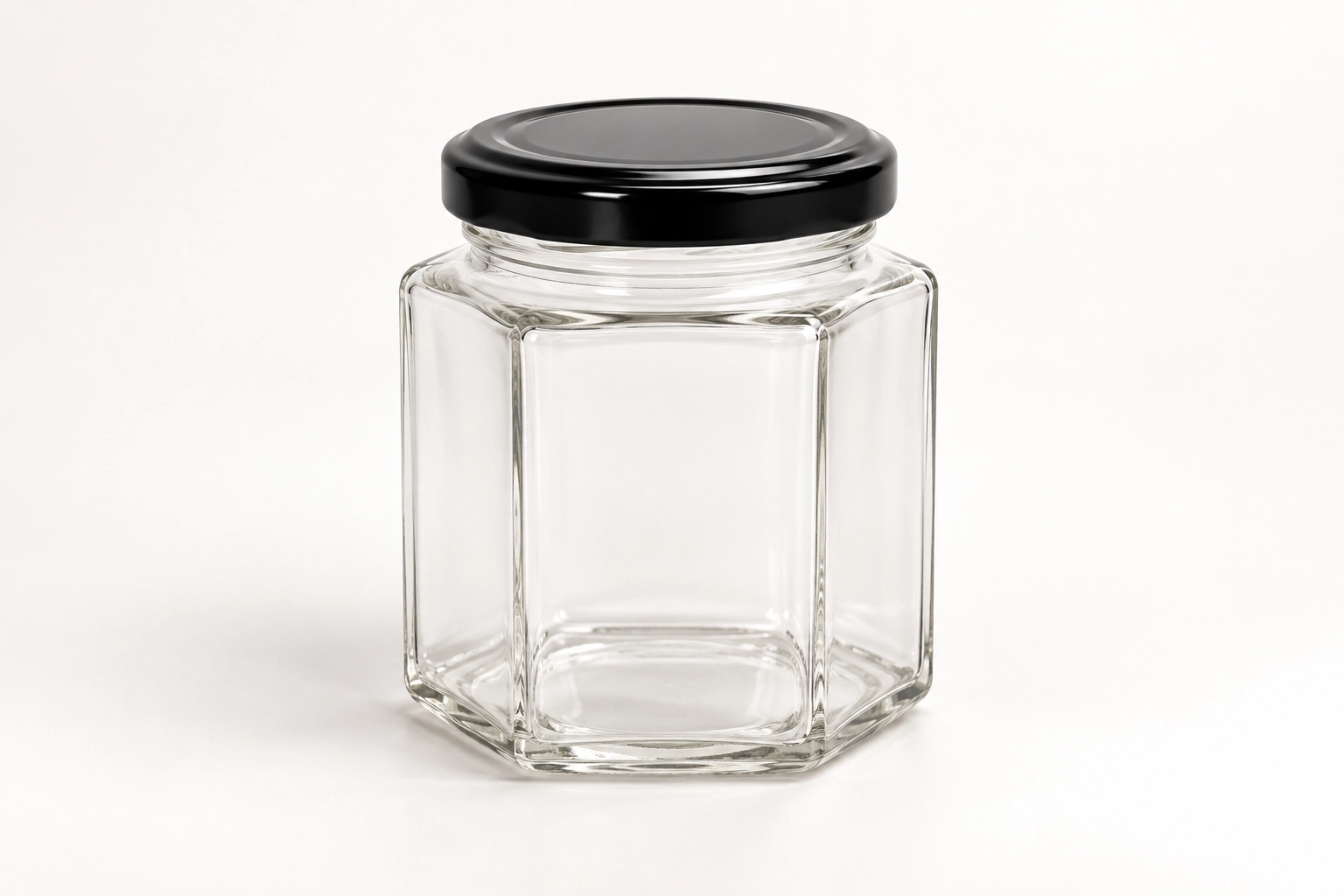
Hexagon Glass Honey Jar Series
Models YGS-SPP0583, YGS-SPP0584 and YGS-SPP0585 form a clear six-sided glass jar series in 85, 100 and 180 ml capacities.
3 options
View specifications