
Packaging Selection
Best Plastic Honey Bottle Shapes for Farmers’ Markets, Grocery Shelves and E-commerce
Compare the best plastic honey bottle shapes for farmers’ markets, grocery shelves and e-commerce, with practical guidance on labels, closures and shipping.
Written by
Gracepack Honey Packaging Editorial Team
Packaging Content & Product Education. We turn the questions customers ask us about honey bottles, jars, caps, samples, filling and export packing into practical packaging guides.
Technical review by
Gracepack Honey Packaging Project Team
Container, Closure & Packing Review. Our project team checks guidance about model selection, fill-weight references, cap compatibility, samples, carton protection and delivery planning.
Reviewed November 13, 2026. Reviewed against Gracepack's current bottle, closure, sampling, packing, documentation and export-project workflow. Final compliance, filling-process and shelf-life approval remains specific to the selected packaging, honey product and destination market. See our quality and document approach.
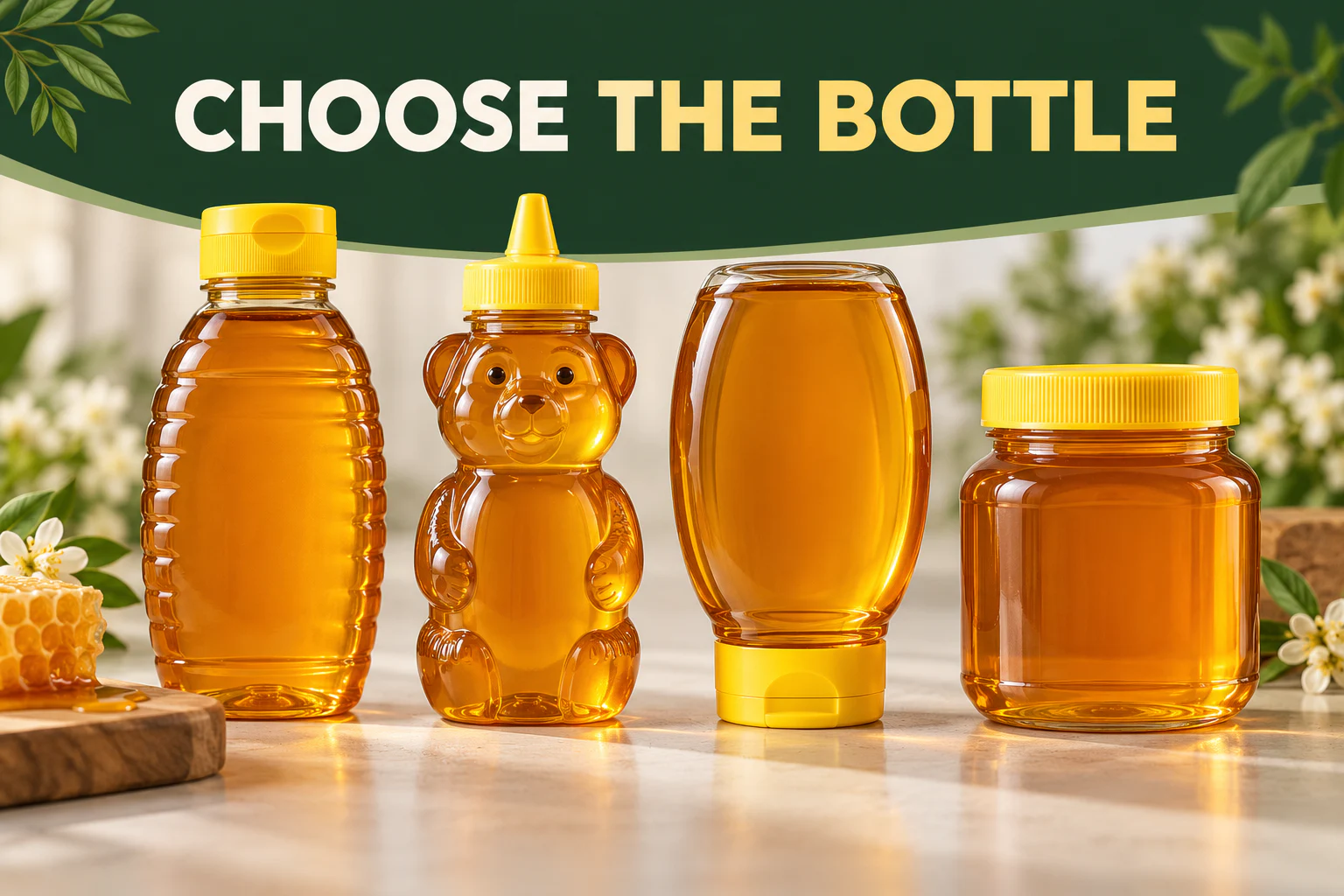
A honey bear can stop a shopper at a weekend market, a broad oval can give a grocery label room to work, and a compact flat-panel bottle can make a shipping case easier to design. None of those advantages exists in isolation. The best plastic honey bottle is the one that suits the channel, protects the honey, works with the closure and filling line, carries the required label, and reaches the customer in good condition.
Choose a Plastic Honey Bottle Shape in 30 Seconds
If most sales happen face to face at a farmers’ market, choose the shape that helps a shopper recognize honey before reading the label. A molded bear, honeycomb texture or comfortable ribbed waist can do that work quickly. Keep the package easy to carry, leave enough flat area for the legally required information, and make sure the format is available in an order quantity that fits the season.
If the bottle must win space in a grocery set, begin with the label and shelf plan. A clear oval or flat-panel PET body usually gives the front panel, back information panel and UPC more predictable surfaces than a heavily sculpted package. Check assembled height, shelf depth, case count and the way the bottle faces forward after shoppers handle it.
If parcel delivery is central to the business, begin with the complete filled pack rather than the silhouette. Compact bodies without fragile projections are easier to separate and cushion. The cap, liner or valve must remain closed when the bottle is on its side, and the shipping case needs enough strength and restraint to keep bottles from striking one another.
A multichannel brand rarely needs a different custom mold for every outlet. One well-proportioned oval or flat-panel bottle can often serve grocery and online orders, while a bear or ribbed format adds a more expressive option for markets, seasonal releases and gift packs. The final choice should be approved with the actual honey, label, closure and case—not with an empty bottle photo alone.
| Shape | Best starting channel | Category recognition | Usable label area | Carton efficiency | Main limitation |
|---|---|---|---|---|---|
| Honey bear | Farmers’ markets and gift-led retail | High | Low to medium; depends on the stomach panel | Medium | Molded details reduce uninterrupted artwork space |
| Oval | Grocery and multichannel programs | Medium | High on broad front and back faces | High when depth is controlled | Curved shoulders limit label height |
| Ribbed or hourglass | Farm stands, markets and everyday squeeze packs | High when the profile signals honey | Medium; ribs must stay outside the panel | Medium | Texture can complicate labels and case contact |
| Flat-panel | Grocery and e-commerce | Medium | High | High | Large panels need enough stiffness to resist distortion |
| Inverted | Convenience-focused grocery programs | Medium to high | Medium to high when artwork is designed cap-down | Conditional | Closure stability and long-term leakage require extra validation |
Farmers’ Markets: Make Honey Recognizable, Portable and Easy to Try
At farmers’ markets, the package often needs to explain the product before the customer reaches the table. The familiar bear silhouette has an advantage because shoppers in the United States already associate it with honey. Honeycomb embossing, beehive ribs and warm yellow closures can create the same category cue without relying on a large headline. That immediate recognition is useful when neighboring stalls are also selling preserves, maple syrup, sauces and baked goods in clear containers.
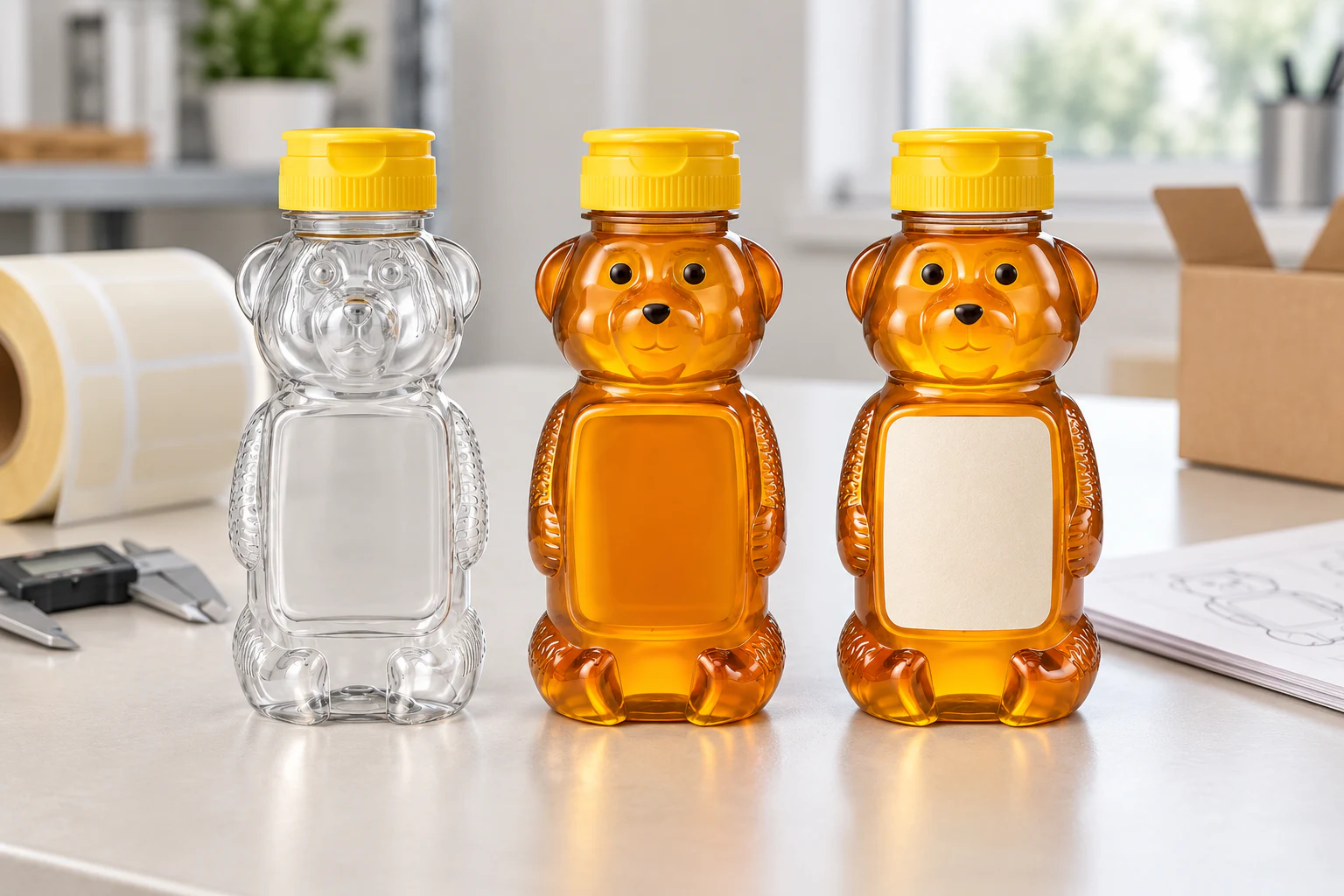
Recognition should not come at the expense of information. A market bottle still needs a readable identity statement, net quantity, business information and any other declarations required for the specific product and market. A molded face, paws or deep ribs can leave less room for a pressure-sensitive label. Before choosing artwork, measure the truly flat panel between curves and raised details. A label that bridges a rib may lift after the bottle is squeezed or exposed to humidity.
Portability also matters. Shoppers may carry the bottle through the market for an hour, place it in a tote with produce, or buy several varieties as gifts. Smaller bear, oval and ribbed bottles can support tasting sets and lower-commitment purchases, while a larger household pack suits repeat customers. The right range depends on how customers buy, not on a universal small-medium-large formula.
Order quantity is especially important for seasonal and local programs. Some established stock models can be sampled and ordered more flexibly than a new custom color or mold, but quantities remain model- and component-specific. The bottle, cap, label and carton may each have a different practical minimum. Ask for those minimums separately before building a seasonal assortment around a format.
For many market-led brands, our PET honey bear bottles provide a useful starting family because the molded shape communicates honey at a glance. The approved model still needs the correct fill level, front-panel label and matched closure. A bear that is charming on an empty sample is only successful when it is also comfortable to squeeze, clean to dispense and easy to pack for the trip to each market.
Grocery Shelves: Give the Label, Barcode and Footprint Room to Work
Grocery packaging has to perform inside a fixed merchandising system. Shelf height and depth are finite, facings are counted, cases are handled quickly, and a UPC must scan without a cashier hunting for it. A bottle with broad front and back faces makes that work easier. Oval and flat-panel bodies can present a clear brand panel toward the aisle and place Nutrition Facts, ingredients, contact information, lot coding and the barcode on a controlled secondary face.
A flat surface is not automatically a usable label surface. The panel must remain stable through filling, labeling, case packing and consumer squeezing. If a lightweight panel draws inward, a large label can wrinkle. If the shoulder begins too close to the artwork, the top edge may bridge a compound curve. If the barcode wraps around the narrow side of an oval, the bars can distort in the scanner's view. Approve the final label on filled production-representative bottles.
Shelf footprint deserves equal attention. A broad front and shallow depth can create strong aisle presence without consuming the space of a round bottle with the same internal volume. Straight sides may improve side-by-side alignment, while small corner radii help resist scuffing. Compare how many filled bottles fit across the intended shelf with the number of empty bottles packed in each shipping carton. They are different calculations, but both affect the packaging plan.
The closure should support the position promised by the label. An upright oval with a flip-top can offer familiar squeeze dispensing. An inverted bottle can signal that the honey is ready at the outlet, but the closure must form a stable, level base. If the package is displayed cap-down, all artwork, lot coding and case orientation need to be designed for that position.
Clear PET is valuable on grocery shelves because color is part of honey's appeal. Pale clover, amber wildflower and darker forest honey can look meaningfully different through the same bottle. Clarity does not replace label communication, but it lets the product become part of the front panel. Resin, wall distribution, mold finish, handling and scuff protection all influence the final appearance.
E-commerce: Design the Filled Pack for Unpredictable Orientation
An e-commerce product image shows the bottle in its best position. Parcel networks do not. The pack may ride on its side, move from warm to cool environments, experience vibration, receive repeated impacts and spend time under compression. Plastic reduces the breakage risk associated with glass, but a plastic bottle can still dent, loosen at the cap, leak through a liner or be damaged when bottles strike one another inside an oversized case.
Compact geometry is a practical starting point. Oval, round and flat-panel bodies without long nozzles or delicate projections are easier to restrain. A shallow oval can reduce unused space, while a straight-sided panel can help build a repeatable divider. The exact winner depends on assembled dimensions, bottle weight, cap diameter and the number of units per order. Calculate case efficiency with the closed bottle, not the body alone.
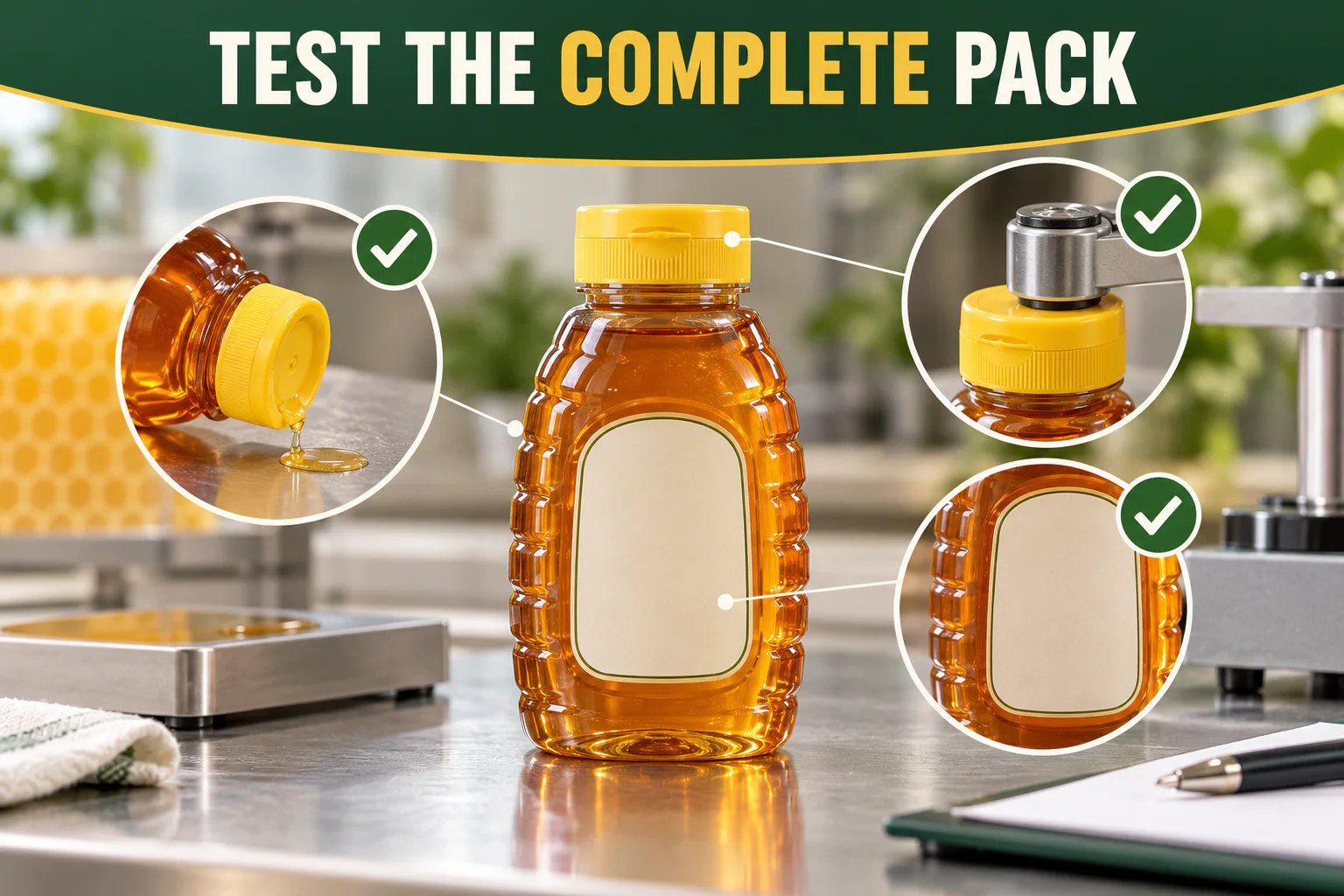
Closure integrity is usually more important than a small difference in bottle shape. Confirm the complete neck finish, cap, liner or valve, application method and torque range. Then evaluate upright, side-rest and inverted storage with the actual honey. A clean bench sample is not enough; temperature, viscosity, residual honey on the sealing land and capping consistency can change the result.
The outer package must control movement and contain the consequences of a failure. Dividers, sleeves, bags, absorbent material or other secondary protection may be appropriate depending on the pack and carrier. A snug carton is not the same as an overcompressed carton. Leave enough room for protective components while preventing bottles from gaining impact distance.
For formal transport development, ISTA Procedure 3A is a recognized general simulation for individual packaged products shipped through parcel delivery systems at 150 lb or less. Referencing the procedure does not mean a package has passed it. The test samples, shipping configuration and acceptance criteria must be defined before the complete filled package is evaluated.
Honey Bear Bottles: The Strongest Traditional Category Signal
The honey bear is one of the few food packages whose silhouette identifies the product without words. That is its main advantage at markets, farm stores, gift shops and family-oriented grocery sets. The molded character can feel approachable, and a clear PET body keeps the honey color visible. It also gives photographers an unmistakable thumbnail for an online listing.
The same molded geometry creates limitations. The face, ears, shoulders and legs reduce uninterrupted label area. A flat stomach panel may accept a compact front label, but the legal information may need a back label, neck band or outer carton. The label should stay inside the flat boundary rather than climbing over fur texture or compound curves. Confirm the panel from a drawing and sample rather than estimating it from the overall bottle width.
Bear bottles also vary significantly in squeeze response. A small bear with a narrow waist may feel very different from a larger flat-panel bear. Bottle material, body weight and wall distribution affect the force required to dispense honey and the ability of the body to recover. Thick or partly crystallized honey can make an otherwise friendly package frustrating, so evaluate the actual product across its expected temperature range.
Carton efficiency is normally adequate rather than exceptional. The ears and molded outline can create spaces between bottles, and the cap may be narrower than the body. A divider or orientation pattern can improve stability. For parcel orders, make sure the ears and closure are not bearing concentrated loads. A bear is a sound choice when recognition is worth the more limited artwork area and somewhat less regular case geometry.
Oval Bottles: A Versatile Shape for Grocery and Multichannel Programs
An oval bottle balances presentation and efficiency. The wide front face gives branding room, while the shallow side profile can reduce shelf depth and improve case arrangement. It feels familiar in the hand without looking generic, and the same family can often support several fill weights with a consistent visual system.
The best label area is usually in the central body. Shoulders and lower heel transitions can curve in two directions, so a label that looks rectangular on a dieline may wrinkle at the corners. Allow a visible margin around the panel. For a back UPC, keep the bars on a surface that the scanner can see without excessive wrap. Test the label stock and adhesive on filled bottles at the labeling temperature and after normal storage.
Oval bottles can be upright or designed for cap-down use. An upright model simplifies conventional shelf presentation and may run more easily on existing conveyors. A cap-down model brings the honey closer to the outlet but changes the center of gravity, artwork orientation and closure duty. Those formats should not be treated as interchangeable simply because both bodies are oval.
Our A54 PET bottle shows why model-specific details matter. It has a 375 mL shoulder water capacity, an approximate 400 mL overflow capacity, a 41/410 neck and assembled dimensions of about 180 mm high by 78 mm across. These figures apply to this configuration rather than to every bottle intended for a 500 g honey fill. They give us a practical basis for discussing shelf height, label area, closure fit and case packing with a customer.
Ribbed and Hourglass Bottles: Grip and Honey-Inspired Texture
Ribbed bottles can communicate honey without becoming a full novelty shape. Horizontal rings suggest a skep or beehive, while a narrow waist gives the hand a clear grip point. This makes the format useful for farmers’ markets, specialty retail and everyday squeeze packs. Ribs can also help a lightweight body feel more controlled when squeezed, although the final response depends on the complete wall design.
The artwork must respect the texture. A label placed across ribs may bridge the valleys, trap air or lift after repeated squeezing. Look for a dedicated flat panel between the textured sides. If the design uses a wraparound label, test whether the stock can conform without hiding the bottle's strongest visual feature. A smaller front label may work better than forcing maximum coverage.
Ribs also affect contact in the shipping case. Raised features can rub against neighboring bottles, and an hourglass waist may allow more movement than straight walls. Examine scuffing after vibration and review whether dividers contact the strongest portions of the body. For market transport, check how the bottle behaves in reusable crates that may be packed and unpacked every week.
Our 180 mL ribbed honey squeeze bottle is a compact PET format that combines side grip with a defined front label panel and a matched flip-top closure. Its approximate honey-weight reference is a starting point; final net weight, headspace, label, outlet and carton packing are confirmed with the selected sample.
Flat-Panel Bottles: Strong Artwork Space With Engineering Responsibilities
Flat-panel is a functional description rather than one single silhouette. A bottle may be oval with two broad faces, rectangular with radiused corners, or a molded character with a deliberately flat stomach. What these formats share is a controlled surface for graphics and scanning. That can be a major advantage when the package carries multiple claims, bilingual copy, a Nutrition Facts panel or a larger UPC.
Large panels must be engineered to stay presentable. Honey is dense, and filled packs place sustained load on the base and sidewalls. During squeezing, a broad panel may flex inward. During cooling after a warm process, pressure changes may also affect appearance. Panel ribs, edge radii, bottle weight and material distribution influence performance. Do not assume that visually flat means structurally rigid.
Flat-panel bottles often pack well because the body depth and side contact can be controlled. They can create consistent rows in a retail case and limit unused air in a parcel carton. However, sharp corners or very broad unsupported faces may concentrate scuffing. Ask for assembled dimensions, the proposed orientation pattern and the actual case count before comparing logistics.
This shape is a strong multichannel candidate when branding and carton efficiency carry more weight than novelty. It can still look distinctive through shoulder design, cap color, label architecture and the visible honey. For many brands, that disciplined flexibility is more valuable than a highly sculpted body that solves only the first purchase.
Inverted Bottles: Convenient Dispensing With a Higher Closure Duty
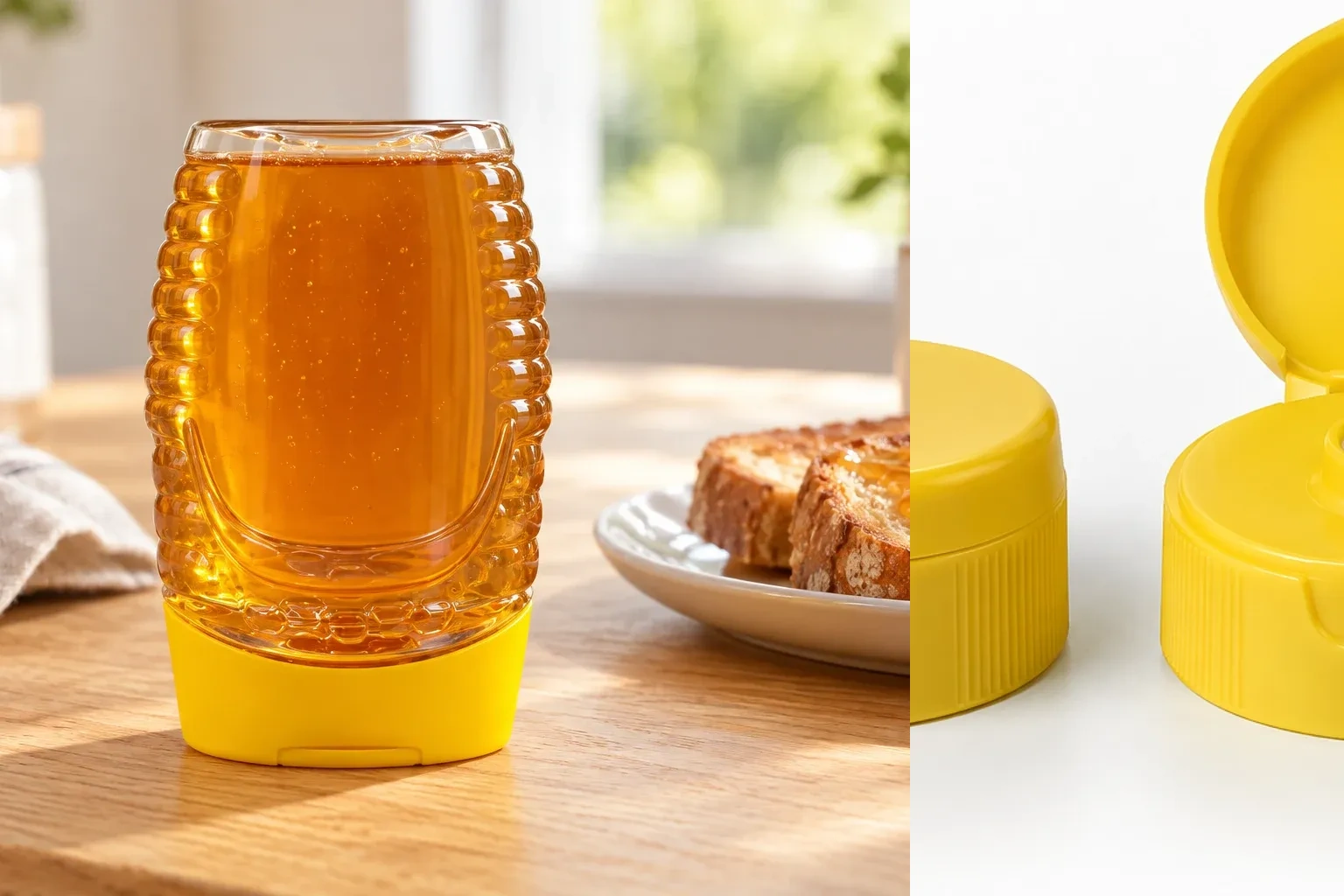
An inverted bottle stores honey close to the outlet. The customer does not need to wait for a partly used bottle to drain before breakfast, and a well-matched valve can provide a cleaner cutoff than an unrestricted opening. That convenience can support a modern grocery proposition and make the package easy to understand in use.
Cap-down storage changes the engineering problem. The closure becomes the base, so its diameter, flatness and stiffness affect stability. The seal or valve is continuously exposed to product pressure. Honey can collect around the outlet, and crystallization may alter opening force or reclosure. The overcap must protect the dispensing surface while remaining easy to open.
Test more than the first squeeze. Evaluate the filled package after storage at expected temperatures, after repeated dispensing and after honey has remained at the valve. Check side-rest and inverted leakage, cap hinge behavior, closure removal torque, opening force, cutoff and stringing. Include the exact honey because floral source, water content, filtration, temperature and crystallization state influence flow.
E-commerce use is conditional rather than automatic. An inverted silhouette may fit a carton efficiently, but any weakness at the valve is directly exposed during transit. Secondary containment and cap protection may be needed. Approve the full pack after the selected closure, seal and carton have been evaluated together.
For a cap-down program, compare inverted honey bottles by body grip, base-cap width, label orientation and the included outlet or valve. A catalog photo cannot confirm whether a valve is present or whether the assembly suits the product. The quotation and approved sample should state every included component.
Match Honey Net Weight to Working and Overflow Capacity
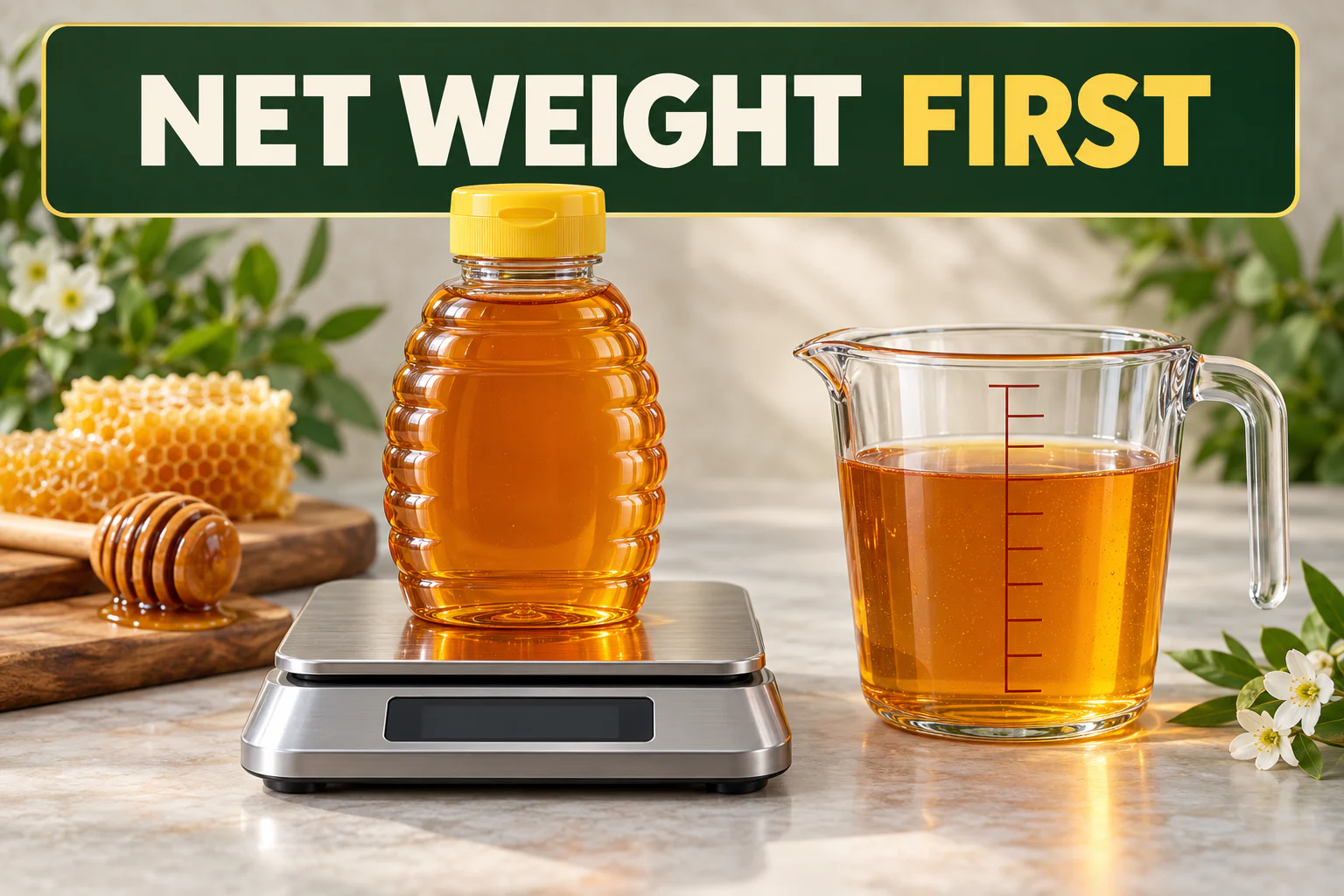
Honey is sold by weight, while a bottle's internal space is measured by volume. Those measurements are related through product density, but they are not interchangeable. A 500 g declaration does not mean the product occupies 500 mL. The actual volume depends on the honey and its temperature, and the bottle still needs enough headspace for accurate filling and clean closure application.
Use measured density at the intended filling temperature to estimate product volume: target net weight divided by density equals the approximate volume occupied by the honey. Treat the result as a planning value. Fill representative bottles, weigh them, inspect the visual level and verify that honey does not contaminate the thread or sealing surface during nozzle withdrawal.
Capacity terms must be defined. A shoulder or recommended-fill water capacity may describe a practical reference level. Overflow or brimful capacity measures to a defined maximum point. Neither automatically becomes the production fill. Different suppliers may use different names, so request the measurement method and the model-specific drawing.
Our A26 PET bottle provides another useful example. It holds about 290 mL at the shoulder and about 300 mL at overflow, with assembled dimensions of roughly 185 × 76 × 58 mm. That capacity difference matters during filling: working too close to overflow can leave inadequate headspace, while using a much larger bottle can make the honey look underfilled and increase shipping volume.
U.S. labels should be developed against the applicable requirements for the actual honey product. The FDA's Proper Labeling of Honey and Honey Products is a useful official starting source. Final label approval remains the responsibility of the business placing the product on the market and its regulatory advisers.
Plan the Label and UPC Around the Real Bottle Surface
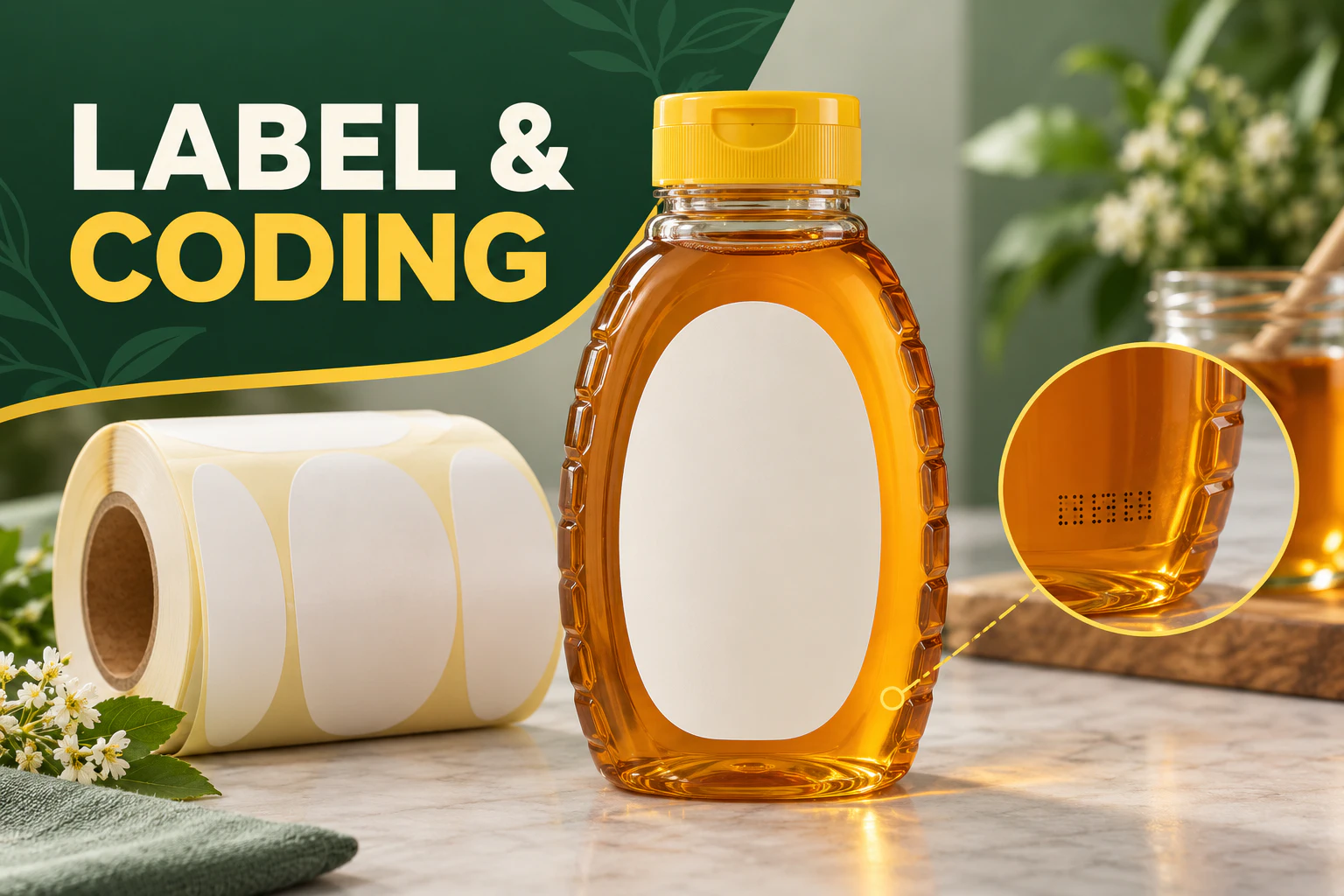
A label drawing should begin with an approved bottle, not a marketing rendering. Measure the usable flat area after allowing for shoulder curvature, heel transition, ribs, mold seams and squeeze zones. The maximum rectangle that can be drawn on a body is not always the maximum label that can be applied reliably at production speed.
For products sold in the United States, plan room for the statement of identity, net quantity, business information, ingredient and nutrition information when applicable, a lot or date code, the UPC and any retailer-specific content. Honey is commonly sold by weight even though the container is described by volume, so the declared net quantity must come from the approved filled product rather than from the bottle’s nominal capacity.
For grocery programs, separate the jobs of the front and back. The front label needs rapid brand and variety recognition. The back or secondary face may carry regulatory information and the UPC. Keep the barcode away from sharp curvature and texture, maintain the quiet zones required by the barcode specification, and confirm scan performance on the finished pack rather than on a flat proof.
Label stock and adhesive should match the application. PET clarity can make bubbles, flagging and misalignment especially visible. Bottles labeled cold, warm or with surface moisture may need different adhesive behavior. If the bottle flexes during squeezing, the label must flex without lifting or creating a permanent wrinkle. If it will be chilled or exposed to market humidity, include those conditions in the trial.
An inverted pack introduces a simple but common artwork mistake: the bottle is photographed upright during development even though it will stand on the cap in stores. Establish the primary display orientation before releasing the dieline. Put the lot code where production equipment can reach it and where the consumer can find it after the package is opened.
Shrink sleeves can cover complex geometry but bring their own distortion, perforation, recycling and application considerations. Direct printing can preserve the shape but may involve higher setup quantities and less late-stage flexibility. Choose the decoration method after the bottle family and annual volume are understood.
Select the Bottle and Dispensing Closure as One System
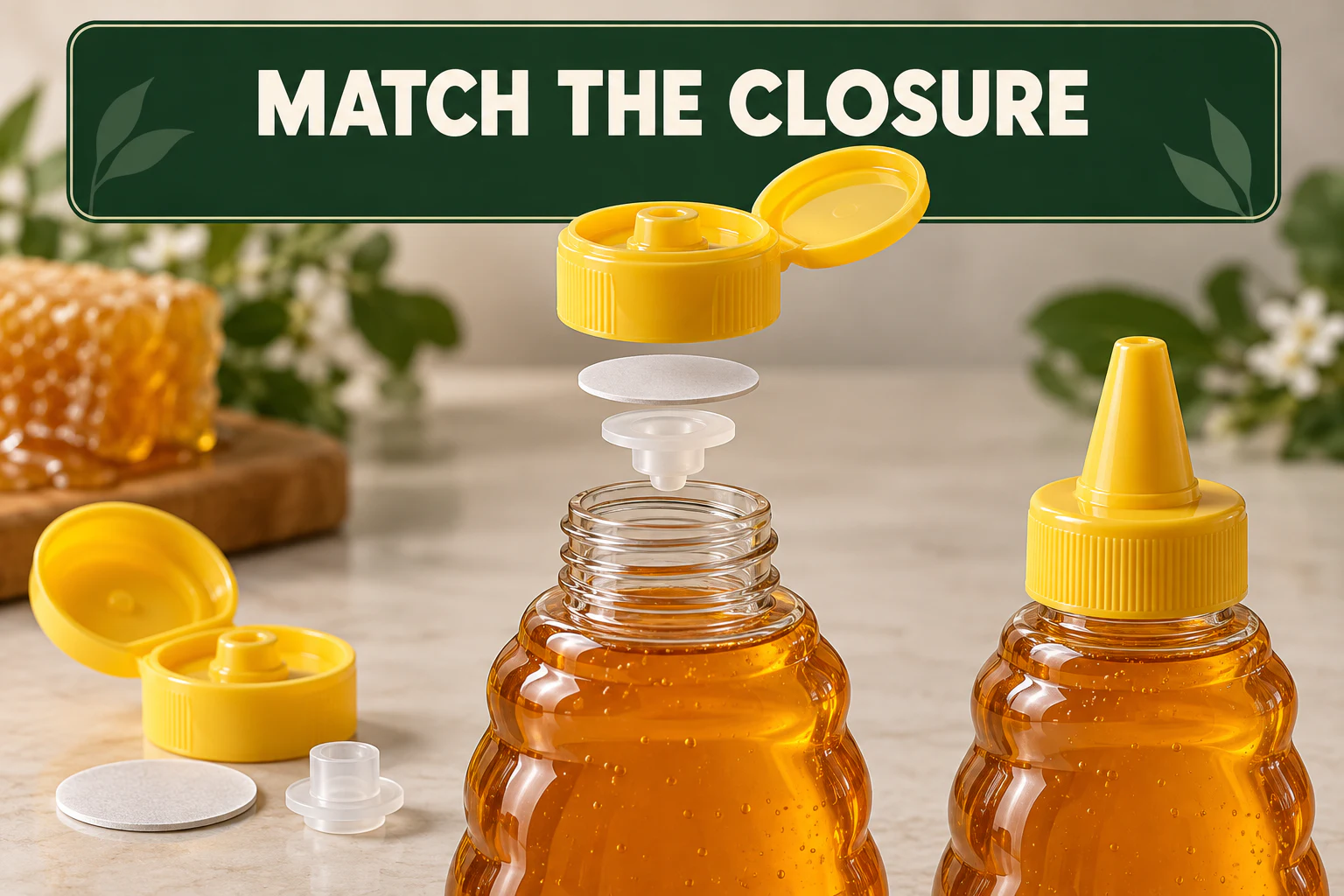
The shape attracts attention, but the closure determines much of the daily experience. Flip-top caps support familiar upright squeezing. Pointed nozzles can improve placement for bakery, foodservice or decorative use. Screw caps with suitable liners provide a simple seal-and-reclose option. Silicone valves can improve cutoff in inverted packs when they are correctly matched to the honey and bottle.
Diameter alone does not prove compatibility. The full neck finish, thread profile, sealing land, plug geometry, liner, valve and application torque must agree. A cap that threads onto the neck may still leak, back off or apply inconsistently. Approve a named bottle and closure combination and record the drawing or revision used for the sample.
Honey viscosity affects outlet choice. A small outlet may give good control with warm, filtered honey and become slow with cooler or partly crystallized product. A large outlet may fill quickly but produce a heavy stream and more stringing. Test at the lowest expected serving temperature as well as at the filling condition.
Capping equipment also belongs in the decision. Confirm cap feeding, hinge orientation where relevant, application torque, head clearance and conveyor stability. Tall pointed caps and wide base caps can change the assembled dimensions enough to affect equipment and case height. Share line drawings or measurements before approving a new shape.
We confirm the bottle body, selected closure and any liner or valve as one assembly, then match available food-contact documentation to the actual components and intended conditions. A report for a PET body does not automatically cover a PP cap, silicone valve, liner, colorant or adhesive.
PET, HDPE and Squeeze Performance: Avoid Choosing by Resin Name Alone
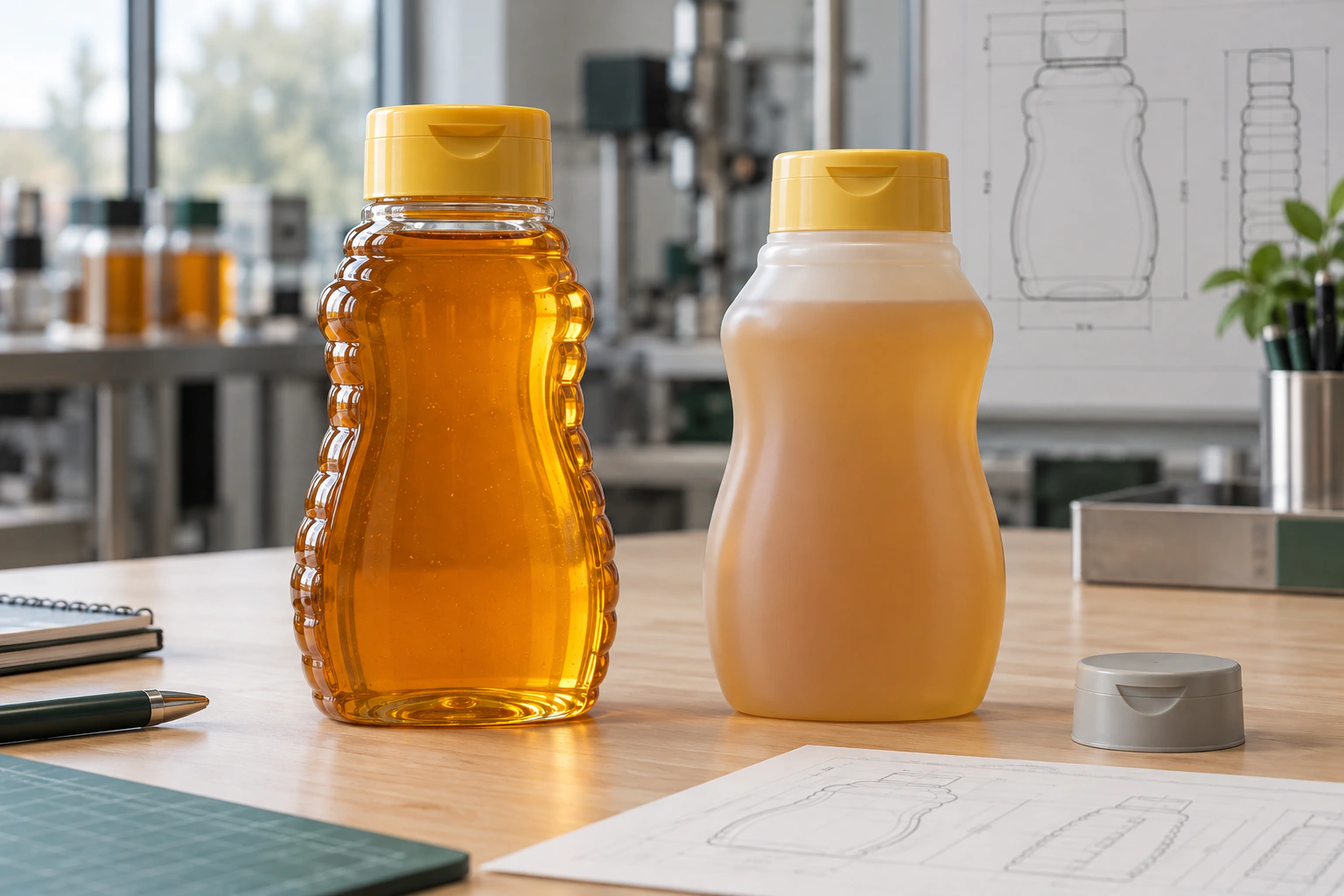
Clear PET is common in honey packaging because it displays color well, is lightweight compared with glass and can form crisp molded details. It is not automatically a soft squeeze material. Body weight, panel geometry, wall distribution and bottle size determine how a specific PET bottle responds in the hand.
HDPE and LDPE can offer a softer squeeze in suitable designs, but they usually provide a more translucent appearance. That may be acceptable for a functional kitchen pack and less desirable when the color and clarity of a varietal honey are part of the purchase decision. Material selection should follow the brand promise, dispensing target and validated use conditions.
Filling temperature must be stated. Standard PET honey bottles should not be assumed to tolerate hot filling simply because PET is used in other hot-fill packages. Resin, preform, blow-molding process, container design and thermal history all matter. Send the normal and maximum product temperature, contact time and cooling method, and obtain written confirmation for the proposed configuration.
For projects intended for the U.S. market, we can provide relevant documentation for review, including PET test reports that reference FDA 21 CFR 177.1630 for the materials tested, PET BPA test reports and our ISO 22000 management-system certificate. We match available documents to the selected material and component instead of presenting one general certificate as if it covered every bottle, cap and filling condition.
Use Carton Math to Compare Shapes Before Ordering
Empty plastic bottles are light and cube-intensive. Freight and storage can therefore be influenced more by volume than by net weight. A bottle that looks economical by unit price may create a less attractive delivered cost if its shape produces a low carton count or an unstable pallet. Request carton quantity, carton dimensions, gross weight and pallet plan for the exact body and closure configuration.
Begin with assembled height, maximum width and maximum depth. Add the cap, hinge, nozzle or supporting base. Then review how bottles alternate or nest inside the case. Oval bottles may rotate to improve density. Flat-panel bottles may form clean rows. Bears and ribbed shapes may need more clearance around molded features. The optimal pattern should not place damaging pressure on a thin panel or closure.
For a simple comparison, calculate the external carton cube per bottle, not just bottles per carton. Divide carton volume by the number of bottles, then consider pallet utilization and container loading. This does not replace a freight quotation, but it reveals when a shape consumes unexpectedly large space. Include any protective materials required for the planned shipping method.
Filled retail cases have a different duty from export cartons of empty bottles. Honey adds substantial weight, and the bottom layer supports the layers above. A carton developed for empty-container export is not automatically suitable for filled-product distribution. The honey packer should approve its own filled case, partitions, stacking height and pallet pattern.
Actual model data makes this comparison useful. Our A26 bottle is packed at approximately 273 empty bottles per carton, while the A54 is packed at approximately 300. Carton quantity alone does not make one option more efficient: carton dimensions, bottle shape, closure packing and delivery conditions also matter. We therefore provide the related packing details with a quotation instead of asking customers to choose by the highest count alone.
Build a Sample and Validation Plan Before Production
The most efficient selection process narrows the field to one or two candidates and then tests them deeply. Collecting a dozen attractive empty bottles can delay the decision because none has been configured with the actual cap, label or fill. Start with the primary channel, target net weight, preferred dispensing method and hard line constraints, then request representative assembled samples.
Fill the samples under realistic conditions. Record honey temperature and density, target weight, fill level, headspace and any product left on the neck after nozzle withdrawal. Apply closures with the proposed equipment or a controlled method. Measure or record application settings so a good result can be repeated.
Evaluate the consumer sequence. Open, dispense, stop the flow, reclose and wipe the outlet. Repeat the cycle after storage. For inverted formats, include cap-down aging and side-rest checks. For upright squeeze bottles, watch panel recovery and air return. For wide openings, check whether honey collects on the thread and whether the liner remains clean.
Apply production-representative labels and scan the UPC from several angles. Inspect for flagging, bubbles, wrinkles and movement after squeezing. Pack the filled bottles in the proposed retail or parcel case and check contact points, closure protection and movement. Transport testing should follow a written plan appropriate to the actual distribution system.
Finish with a controlled approval record: model number, drawing revision, bottle weight, capacity definitions, closure and liner, color, label reference, sample date, packing specification and accepted exceptions. That record becomes the repeat-order reference and reduces the risk of solving the same questions again.
Create a Practical Multichannel Bottle Portfolio
A brand selling through several channels does not need every available shape. Too many bodies multiply label versions, cap components, sample approvals, case sizes and inventory risk. A focused portfolio can express different occasions while keeping the operating system manageable.
A practical starting portfolio might use a broad oval or flat-panel PET bottle as the core grocery and online format. It carries a strong label, packs predictably and can support several honey varieties. A bear or ribbed bottle can add a more expressive market and gift option. An inverted bottle can become a convenience-led extension after the closure and filled-pack program is validated.
Keep common components where the performance allows it. Shared neck finishes, cap colors, label materials and carton footprints can simplify purchasing and line setup. Do not force commonality where it creates a weak seal or poor dispensing. A component is only common if it is confirmed for every named bottle.
Use visual consistency rather than identical geometry to connect the range. The same label architecture, typography, cap color and honey visibility can make a bear, oval and inverted bottle feel like one family. This gives each channel a suitable format without making the brand look fragmented.
Review the portfolio annually against actual sales, damage, leakage, label complaints, line downtime and inventory. A bottle that looked distinctive at launch may be adding unnecessary complexity. A plain-looking core bottle may be the format customers reorder most easily. Decisions improve when real operating feedback is connected to the packaging specification.
Choose Between a Stock Bottle and a Custom Mold
A stock bottle is usually the most sensible starting point when a honey brand is testing a new channel, introducing a seasonal variety or building its first repeatable packaging specification. Existing models let the team evaluate filled weight, label fit, dispensing and case packing before making a tooling commitment. They also make it easier to compare more than one shape with real honey instead of judging a concept rendering.
Stock does not mean generic in the hands of a thoughtful brand. Cap color, label architecture, tamper evidence, case presentation and the choice of honey can create a distinctive package without changing the bottle mold. A broad oval with a restrained label may suit a premium varietal honey, while the same body with a brighter label and flip-top cap can support an everyday family line. The bottle provides the operating platform; the complete presentation creates the identity.
A custom mold becomes worth discussing when the shape solves a defined business or operating problem that available bottles cannot solve. Useful reasons include a protected label panel of a particular size, a footprint that improves a confirmed shelf or case constraint, a grip feature needed for the intended filled weight, or a proprietary silhouette that is central to the brand. ‘We want something unique’ is not yet a mold brief. The new geometry needs measurable requirements and an expected production program.
Customization also adds decisions that stock selection has already resolved. The team must establish target capacity, overflow allowance, material distribution, neck finish, top-load behavior, squeeze response, mold parting lines, label limits, base stability and acceptable visual variation. Prototype and pilot samples must be evaluated with the selected closure and actual product. Tooling approval should be based on a controlled drawing and physical evidence rather than a front-view image alone.
For a farmers’ market brand, a custom shape can consume cash and time that would be better used to prove demand, improve artwork or build a reliable selling schedule. For an established grocery or online program, it may be justified when annual volume and a clear operational benefit support the project. In either case, begin by documenting what the stock alternatives fail to do. That list keeps customization focused on useful improvement instead of decoration for its own sake.
Check the Filling and Capping Line Before the Bottle Is Approved
A bottle can perform well in a customer’s hand and still create trouble on the packaging line. Tall narrow bottles may wobble at conveyor transfers. Pronounced ribs can reduce the surface available for guides. A wide oval may need consistent orientation before labeling. An inverted bottle may require a supporting cap or fixture. These issues are easier to correct during selection than after printed labels and closures have been purchased.
Record the full assembled dimensions, not just the nominal body size. Maximum width, depth and height should include the closure in its production position. Check the contact areas used by guide rails, timing screws, star wheels, puck systems and case packers. If the line relies on side pressure to stabilize a bottle, a flexible panel or irregular molded feature may change how it travels. Run enough filled units to see normal variation rather than relying on a single carefully handled sample.
The filling nozzle needs sufficient clearance at the neck and a withdrawal path that does not drag honey across the sealing surface. The product temperature and viscosity affect stringing, drip cutoff and fill time. A bottle with a narrow opening may present neatly at retail but slow the line if the selected nozzle cannot enter cleanly. A wider neck may simplify filling but require a different closure and change the consumer’s dispensing experience. These decisions belong in one review.
Capping deserves the same attention. Confirm the neck finish, closure thread or snap feature, liner or seal, application method and target settings on production-representative equipment. A cap that can be tightened by hand during sampling is not automatically suitable for a repeatable line. Excessive application force can distort a flexible bottle or damage threads; inadequate application can allow leakage. Hinged flip-tops and pointed nozzles also need orientation and downstream clearance checks.
Labeling trials should use the final container state whenever possible. A flexible bottle may change shape after hot product is filled or when side pressure is applied. Clear PET makes trapped air, adhesive wet-out and label wrinkles especially visible. Test sensors against the real bottle and honey color, confirm the gap between labels, and evaluate barcode scans at normal line and retail angles. A successful package is one that can be produced consistently, not merely assembled once.
Turn Farmers’ Market Sales Into Better Packaging Decisions
Weekly setup reveals practical details that are easy to miss in a studio. A filled bottle should be comfortable to carry, stable on a stepped display and secure in a tote beside produce. Shorter formats often travel well in reusable bins, while a clean, reliable cap matters more than perfect pallet efficiency for a small market program.
Seasonality should shape the buying plan. Spring markets, holiday gift sales and year-round farm shops may need different quantities or label versions. A stock bottle lets a producer learn which sizes sell before investing in a custom mold. Cap color, label accents and neck tags can distinguish varieties without creating a separate bottle inventory for every harvest.
Record what happens at the table: which bottle customers pick up first, which net weights sell through, whether closures become sticky and which questions recur. Separate packaging feedback from comments about price, flavor or artwork. Several market cycles can provide useful evidence for a future grocery line, online pack or custom package.
Prepare the Grocery Case and Item Data
Build a dimensioned shelf view from the maximum assembled height, width and depth, then compare it with the expected shelf clearance and number of facings. The bottle needs a stable base, a closure that does not make it top-heavy and a front that returns to the aisle after normal handling.
Design the filled retail case for the store rather than reusing the carton that carried empty bottles. Employees should be able to identify and remove units without catching labels or flip-top hinges. If a corrugated tray remains on the shelf, its front wall should not hide the label. Case quantity should reflect likely sales velocity as well as packing efficiency.
Provide consistent item data from production-representative packages: assembled dimensions, filled weight, case pack, case dimensions, UPC, storage orientation and pallet information where required. Recheck the data whenever a new cap, label or bottle revision changes the finished package.
Build the E-commerce Pack Around the Actual Order
A single bottle, a two-pack, a mixed tasting set and a full case create different movement and leakage risks. Test the configurations customers will actually receive. A compact bottle that ships well alone may still need partitions in a multipack, while a bear bottle may need clearance around its molded features and closure.
The shipping case should restrain the bottles without pressing a flip-top open or loading a flexible panel for long periods. The customer should also be able to remove the product without cutting the label or fighting excessive tape and loose fill. Secondary protection can limit the consequences of a failure, but it cannot replace a dependable bottle-and-closure seal.
Use return data to identify the failure mechanism. A report of leakage may come from an under-applied cap, a cracked hinge, honey on the sealing surface, a failed liner or an impact that opened the closure. Correcting the specific cause is more reliable than changing the bottle shape without evidence.
Compare Total Packaging Cost Instead of Bottle Price Alone
The bottle price is visible, but it is only one part of the cost to place a reliable honey package in a customer’s hand. The closure, liner or seal, label, decoration, assembly, filling speed, scrap, cartons, partitions, freight, storage and damage all belong in the comparison. A less expensive body can cost more if its carton cube is poor or its label surface requires a slower and more complicated application.
For farmers’ market sales, include the cost of carrying inventory through a seasonal schedule. A distinctive shape may support a higher perceived value, but a large minimum order can leave cash tied up in packaging after the market closes. A flexible stock option with shared closures and label materials may be more valuable than a slightly lower unit price available only at a much larger quantity. The useful comparison follows the expected sell-through, not an ideal annual forecast.
For grocery, add case packing and line labor. A bottle that feeds, fills, caps and labels reliably can protect production time. If operators must hand-orient every bottle, wipe honey from a difficult neck or rework labels around deep ribs, the apparent container saving can disappear. Retail deductions, unreadable barcodes and damaged cases also belong to the program even when they do not appear on the packaging supplier’s invoice.
For e-commerce, calculate the cost per order configuration. A compact shape may allow a smaller shipping box, more efficient case storage and less cushioning. A larger decorative bottle may be profitable if its presentation supports the offer, but the protective pack and dimensional shipping effects should be known. Include replacement product, reshipment, customer service and lost repeat purchases when comparing leakage and damage outcomes.
Keep the model transparent. List each assumption, note whether it is quoted or estimated, and run more than one volume scenario. Do not invent savings from carton count without the actual carton dimensions and shipping route. Total cost analysis is most useful when it exposes the few variables that change the decision. Often those variables are sell-through, line speed, case cube and failure rate rather than a small difference in bottle price.
Work Through Three Typical Honey Packaging Decisions
Consider a small apiary that sells eight-ounce and twelve-ounce packages at weekend markets and through a farm shop. Immediate category recognition, manageable seasonal inventory and easy handling are more important than maximum carton density. A stock honey bear or ribbed bottle is a sound starting point. The producer can compare two filled sizes, confirm that the label carries the required information, and use one compatible closure color across varieties. After a selling season, actual demand can guide the next order instead of an optimistic forecast.
Now consider a regional honey brand preparing for independent grocery stores. The package must face well, leave a dependable back panel for information and UPC placement, move through a repeatable filling process, and arrive in a practical retail case. A broad oval or flat-panel PET bottle will usually deserve the first trial. The team should build the artwork from the measured label area, run scan checks on filled samples, confirm assembled shelf dimensions and prepare accurate case data before presenting the item.
A third brand sells flavored honey and gift sets primarily online. The listing needs a clean silhouette, but parcel reliability and multipack efficiency carry greater weight than dramatic molded detail. A compact oval or flat-panel body with a protected closure is a practical core format. The shipper can be designed for one-, two- and three-bottle orders, then tested as complete filled configurations. A decorative bear may still appear in holiday sets when the additional protection and shipping cost are understood.
An inverted bottle can enter any of these programs when clean, one-handed dispensing is central to the experience. It should not be added merely because cap-down packaging looks modern. The selected valve, outlet and overcap must work with the honey’s viscosity and crystallization behavior, while the filled assembly remains stable in storage and secure in transport. A conventional upright bottle may be the better choice when customers refill containers, when the line cannot support cap-down bodies, or when the sales channel values a familiar opening sequence.
These examples are starting points, not fixed rules. A premium farmers’ market honey may benefit from a restrained oval and elegant label; a grocery set may use a bear to strengthen family appeal; an online subscription may ship an inverted bottle successfully in a dedicated insert. The disciplined approach stays the same: rank channel requirements, select a short list, measure the real models, fill and decorate samples, test the intended case, and approve one written configuration. Shape follows the job the package must perform.
When two candidates remain equally suitable, choose the one that is easier to specify, source, run and reorder consistently. Operational clarity is a durable packaging advantage.
What to Send When You Request Bottle Samples or a Quotation
A useful first inquiry does not need a finished engineering drawing, but it should describe the job clearly enough to select relevant samples. Start with the target honey net weight and the primary selling channel. Add the honey type, normal filling temperature, preferred dispensing style and whether the package will stand upright or cap-down.
State the order quantity and annual estimate separately. A first production order, seasonal requirement and long-term forecast answer different questions. Include the delivery city or port so packing and freight assumptions can be reviewed. If an existing filling line sets a maximum height, conveyor width, nozzle diameter or capping limitation, share those constraints at the beginning.
Send label intentions as well: front-and-back pressure-sensitive labels, wrap label, sleeve or direct print. If a grocery customer has provided a shelf height or UPC requirement, include it. If the bottle will be sold online, describe the common order configuration—one bottle, a two-pack, gift box or case—because the protective pack may influence the recommended shape.
We use these details to narrow the choice to a practical bottle-and-closure sample set, confirm model-specific capacity and dimensions, identify the usable label area, and prepare packing information for the quotation. If a stock bottle does not meet the project requirements, the same information gives us a sound basis for discussing a custom package instead of beginning with an isolated rendering.
The most useful opening message includes: target net weight, measured density if available, filling temperature, bottle orientation, closure function, label method, filling-line limits, initial quantity, destination and primary channel. Unknown items can remain open to recommendation. They should be resolved through drawings, samples and written approval before production.
| Project input | Why it changes the recommendation | Useful format |
|---|---|---|
| Target honey net weight and density | Establishes working volume and headspace | Weight, density, measurement temperature |
| Primary and secondary channels | Sets priorities for recognition, shelf and parcel performance | Expected sales share by channel |
| Honey condition and filling temperature | Affects flow, outlet, bottle use condition and trials | Normal range plus maximum |
| Closure and dispensing target | Determines neck, cap, liner or valve requirements | Upright flip-top, nozzle, screw cap or cap-down valve |
| Label and UPC plan | Determines usable panel and artwork orientation | Label type, approximate dimensions and required panels |
| Line constraints | Prevents height, handling, nozzle and capping conflicts | Equipment details or maximum dimensions |
| Quantity and destination | Determines available routes, packing and quotation basis | Initial order, forecast, city or port |
Plastic Honey Bottle Shape FAQs
Which plastic honey bottle shape is best for farmers’ markets?
A honey bear is a strong starting point when immediate honey recognition and family appeal matter. Ribbed, hourglass and honeycomb-inspired bottles can support a more artisanal presentation. The final choice should still provide enough label area, a comfortable filled weight and an order quantity that fits the selling season.
Which honey bottle shape provides the most label space?
A broad oval or flat-panel bottle generally provides the most predictable front and back label areas. The usable label size is smaller than the overall body dimensions because the artwork must avoid curved shoulders, heel transitions, ribs and mold seams. Confirm the dieline on an approved physical sample.
Is an inverted honey bottle suitable for e-commerce shipping?
It can be, but only after the complete filled package is validated. The base cap, valve or outlet, seal, overcap and carton must be checked for cap-down and side-rest leakage, repeated dispensing and the stresses expected in parcel distribution. Shape alone does not prove shipping suitability.
Are honey bear bottles difficult to label?
They have less uninterrupted artwork space than most oval or flat-panel bottles because the molded face, shoulders, paws and fur details occupy the body. Many bear designs include a flat stomach panel for a front label. Measure that panel and keep the label inside its flat boundary.
What is the difference between honey net weight and bottle capacity?
Honey net weight describes the weight of product in the package. Bottle capacity describes internal volume. Convert the target weight to an estimated product volume using measured honey density at the filling temperature, then confirm the fill level and headspace with representative filled samples.
Is PET suitable for squeeze honey bottles?
PET can be suitable when the body geometry, bottle weight and wall distribution provide the intended squeeze and recovery. PET is not automatically as soft as LDPE. Test the selected bottle with the actual honey across the expected serving-temperature range.
Should I choose a bottle by the number of units per carton?
Carton quantity is only one part of the comparison. Review carton dimensions, cube per bottle, protective materials, pallet utilization and the condition of the bottle after transport. Filled-product cases also require a separate design because honey adds substantial weight.
What should be checked before approving a grocery honey bottle?
Confirm shelf height and depth, front-facing stability, usable label panels, UPC scan performance, fill level, closure fit, dispensing, case count, scuffing and filling-line handling. Approve the final label on a filled production-representative sample.
Can one plastic honey bottle serve markets, grocery and online sales?
A well-proportioned oval or flat-panel bottle can be a practical multichannel core because it balances label space, grip, shelf footprint and carton efficiency. A brand may add a bear or ribbed bottle for market and gift programs when the added recognition justifies another specification and inventory line.
What information should I send before requesting samples?
Send the target honey net weight, honey type and density if available, filling temperature, preferred orientation and closure, label method, production-line limits, initial quantity, destination and primary sales channel. We can use those details to narrow the sample set and identify the remaining approval checks.
Related Products
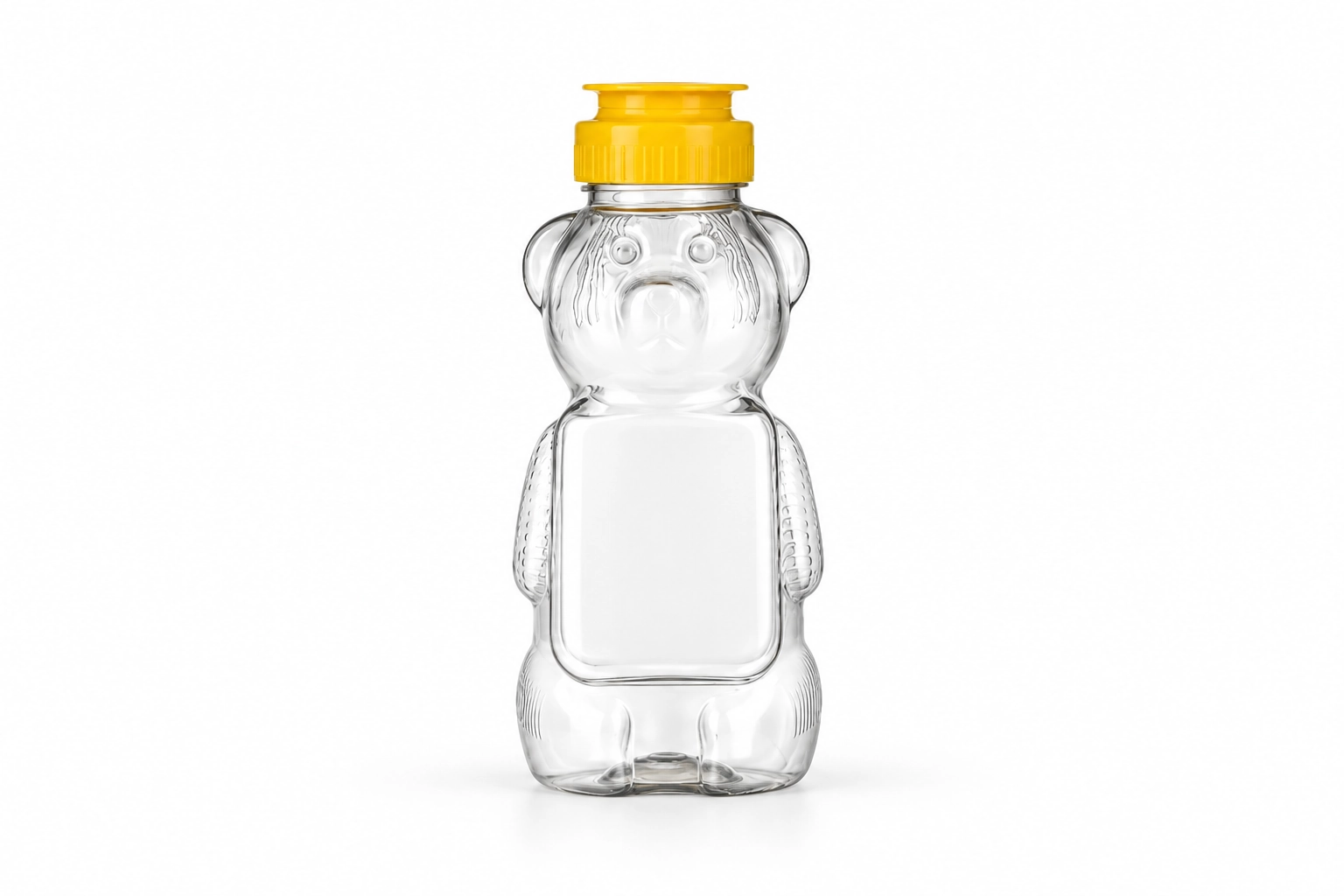
320 ml PET Honey Bear Bottle
Model G-05 is a clear 320 ml PET honey bear bottle with a defined front label panel and matched 38-400 PP flip-top cap.
1 option
View specifications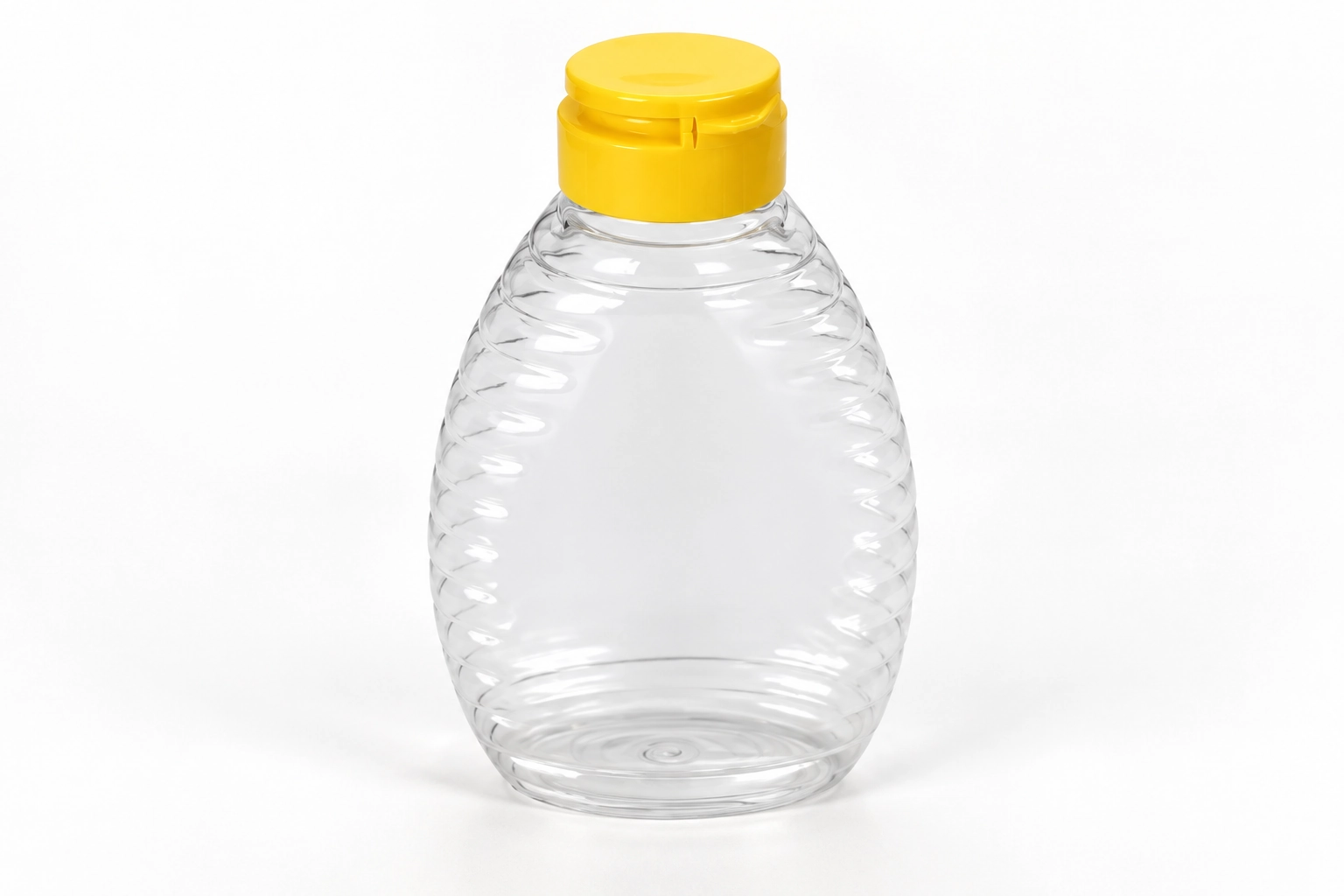
180 ml Ribbed Honey Squeeze Bottle
Model G-07 is a clear 180 ml PET honey squeeze bottle with ribbed side grips, a flat front label panel and matched 28-400 PP flip-top cap.
1 option
View specifications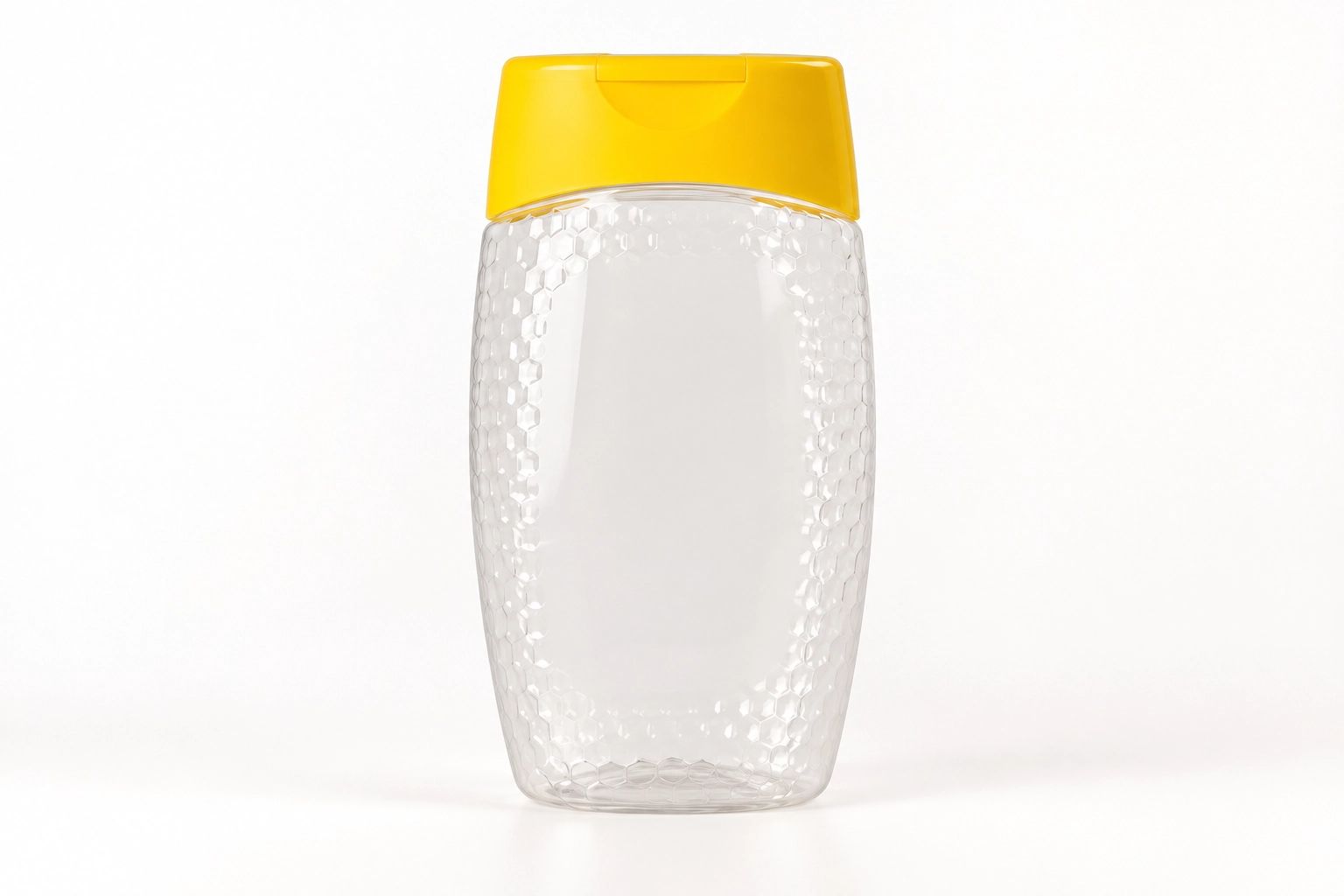
360 ml Oval Inverted Honey Bottle
Model G-12 is a clear 360 ml oval PET bottle developed for cap-down honey dispensing.
1 option
View specifications