
Packaging Selection
Inverted Plastic Honey Bottles: How Top-Down Packaging Maximizes Consumer Convenience
Compare inverted plastic honey bottles, valve performance, shelf stability, fill testing and US or Australian pack formats before sourcing.
Written by
Gracepack Honey Packaging Editorial Team
Packaging Content & Product Education. We turn the questions customers ask us about honey bottles, jars, caps, samples, filling and export packing into practical packaging guides.
Technical review by
Gracepack Honey Packaging Project Team
Container, Closure & Packing Review. Our project team checks guidance about model selection, fill-weight references, cap compatibility, samples, carton protection and delivery planning.
Reviewed October 16, 2026. Reviewed against Gracepack's current bottle, closure, sampling, packing, documentation and export-project workflow. Final compliance, filling-process and shelf-life approval remains specific to the selected packaging, honey product and destination market. See our quality and document approach.
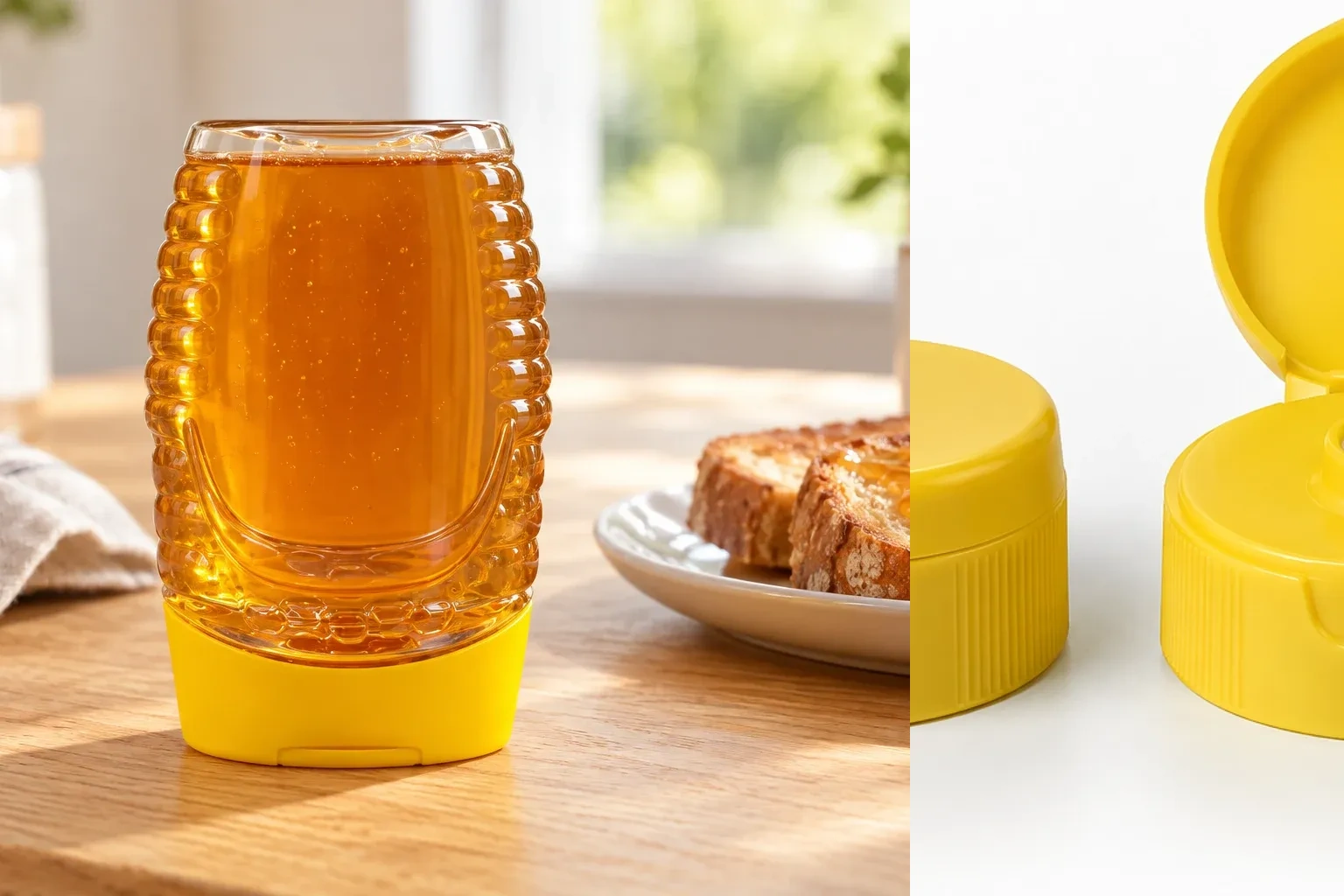
An inverted honey bottle changes a familiar kitchen routine. Instead of turning a pack over and waiting for viscous honey to reach the outlet, the product is already positioned above the closure. A squeeze can begin quickly, and a well-matched valve can stop the stream without leaving a long sticky tail. That convenience explains the format's growing shelf presence in the United States and Australia, but the cap-down orientation also keeps honey against the closure continuously. Success depends on the entire bottle, cap, valve, seal and filling process—not the silhouette alone.
Gravity-Fed Dispensing: Reducing the Honey Left Waiting at the Bottom
A conventional upright bottle stores honey at the end opposite the outlet. When the pack is nearly empty, the consumer must turn it over, wait, shake it or leave it balanced on its cap. A top-down honey dispenser makes that inverted position the normal storage position. Gravity keeps the product near the orifice, so the next serving can start with less waiting and fewer hard shakes.
This is especially noticeable with cool or partly crystallized honey. At breakfast, a parent making toast, a café worker sweetening drinks or a baker measuring a small amount can open and dispense with one hand while the other hand holds the food or utensil. The same behavior suits the fast, casual use expected from squeeze condiments in US kitchens and the familiar inverted honey packs found in Australian supermarkets.
Gravity does not empty every bottle completely. Honey still coats sidewalls, collects around shoulders and moves more slowly as temperature falls. Deep ribs, abrupt waist transitions and broad flat panels can create local hold-up. The valve also retains a small product column. Treat improved evacuation as a measurable design goal rather than a fixed percentage claim.
A useful comparison weighs each filled bottle before opening and again after a defined number of normal squeezes. Record the residual product, dispensing time and hand force at several temperatures. Repeat the procedure with the same honey batch in an upright control bottle. That test shows whether the new geometry delivers a meaningful advantage for the intended product rather than only looking more convenient on shelf.
| Use condition | What gravity helps | What still requires engineering |
|---|---|---|
| First use | Honey is already close to the outlet | Inner-seal removal and a clean first dispense |
| Daily household use | Less waiting between opening and dispensing | Opening pressure, squeeze force and bottle recovery |
| Near empty | Remaining honey continues to move toward the cap | Shoulder drainage, internal ribs and residual product around the valve |
| Cool pantry | Orientation is helpful even when flow slows | Real-temperature testing with crystallized or high-viscosity honey |
| Transport and storage | No dispensing benefit while closed | Continuous product contact, leakage resistance and closure security |
The Valve Is the System: Opening Pressure, Cut-Off and Bottle Recovery
The dispensing valve determines when honey begins to flow and when it stops. A cross-slit elastomeric valve normally stays closed under the static head of product, opens when bottle pressure exceeds its threshold, and returns toward the closed position when the consumer releases the bottle. The slit pattern, valve diameter, material stiffness and retaining geometry all affect that sequence.
Opening pressure must match the bottle. If the threshold is too high for a relatively rigid PET body, users may squeeze hard enough to crease the panel before the valve opens. If it is too low, a warm bottle stored cap-down can seep. After dispensing, the bottle also needs a route for pressure equalization. Poor recovery can leave the walls dented or draw residue back unpredictably around the outlet.
Honey adds another variable because its viscosity changes sharply with temperature and crystallization. The valve that produces a controlled ribbon with warm, filtered honey may hesitate or require excessive force with a cool, minimally processed product. A larger opening is not automatically cleaner; it may create a heavy surge followed by a long tail. The correct choice balances the desired portion, opening force, cut-off and leakage resistance.
Flow-control specialists likewise match valve diameter and slit configuration to the product and validate the complete package. Aptar's overview of flow-control valve testing describes compatibility and performance evaluation during package development. The same principle applies here: approve a valve with the selected honey, bottle and closure, not as an isolated component.
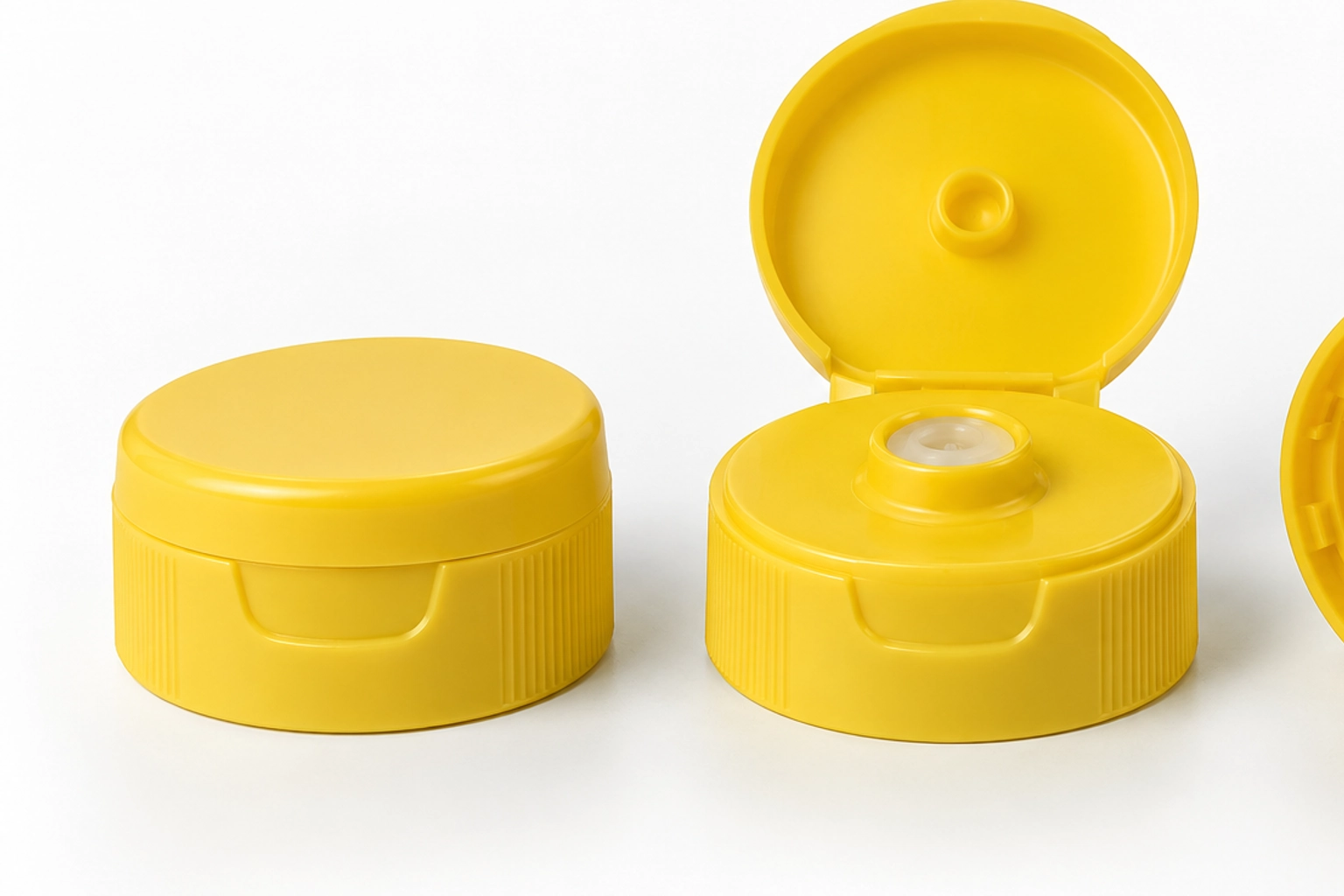
Gracepack's valve caps for inverted honey bottles use a wide-base PP closure with a silicone valve option for compatible assemblies. The available material and general format identify a development route; model-specific fit, valve choice, color and packing still need confirmation on the selected bottle.
Wide Footprint Cap Engineering: Stability Is More Than Cap Diameter
An upside down honey squeeze bottle stands on its closure, so the cap becomes part of the primary structure. A wider footprint can reduce rocking and gives the bottle a broad platform, but diameter alone does not determine stability. The cap land must be flat, the hinge and opening tab must remain within the support envelope, and molding distortion must not create high spots.
Bottle height and filled center of gravity matter just as much. A tall, narrow body can still tip easily on a large cap, particularly when shoppers return it to a refrigerator door shelf or when bottles move along a conveyor. An asymmetric label, off-center fill or cap that does not seat squarely can add lean. Stability should be checked with full, half-full and nearly empty packs because the center of mass changes during use.
The closure also absorbs impacts when the pack is placed down. A hinge projecting beyond the base can strike the counter first, while an opening tab that sits too close to the surface may be awkward to lift. The design needs clearance for fingers without turning the tab into a lever that opens during case packing or parcel delivery.
Measure static tip angle, base flatness and wobble on filled samples. Then repeat after heat exposure, cold storage and distribution conditioning. For e-commerce, include drops in several orientations and hold the pack cap-down afterward to reveal slow seepage. For retail, test the bottle on the actual shelf tray and confirm that front-facing packs remain upright after adjacent bottles are removed.
- Verify that the entire closure base, rather than the hinge or tab, contacts the shelf.
- Record filled-bottle lean and wobble with production-intent caps applied at the target torque.
- Check full, half-full and low-fill stability on a level surface and the intended shelf tray.
- Inspect cap-down packages after hot-cold cycling, vibration and drop testing.
- Confirm that the closure height fits case dimensions without carrying top load on the opening feature.
Flat Label Panels vs. Ergonomic Waist Contours
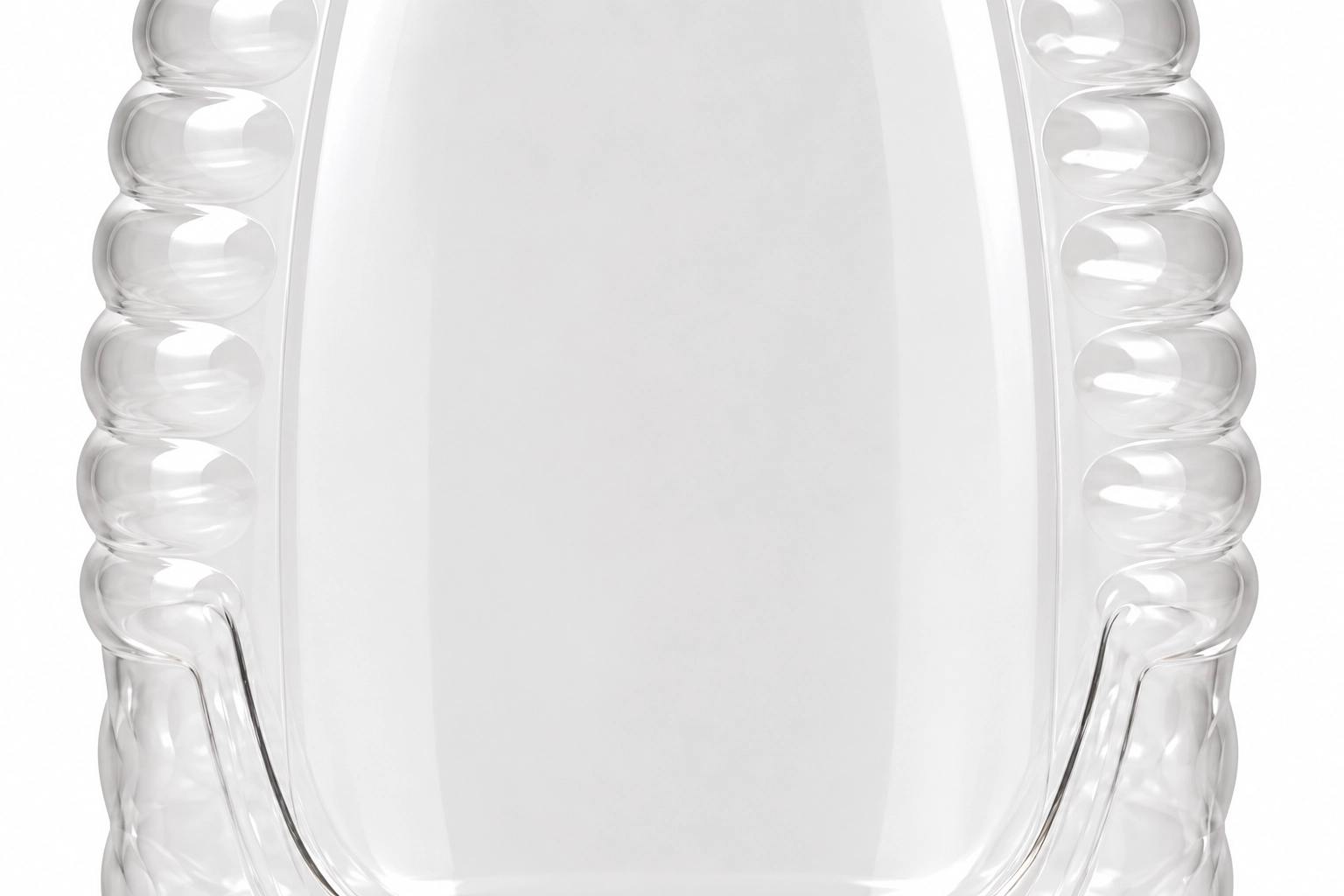
The bottle body has to solve two different jobs. It needs a comfortable squeeze zone for the hand and a predictable surface for branding, ingredients, nutrition information and barcodes. A broad flat front panel can support pressure-sensitive labeling and keep small type readable, but a very stiff panel may raise squeeze force or collapse abruptly. A narrow waist improves grip but reduces usable label width and can pull label edges into compound curves.
For a front-and-back label program, define the usable panel inside the molded boundary rather than using the bottle's maximum width and height. Keep label corners away from ribs, waist transitions and parting lines. Apply production-intent labels to filled bottles, cycle them through repeated squeezes, and inspect for flagging, wrinkling and adhesive read-through.
Clear PET makes the honey color part of the display. That can give golden or amber varietals strong shelf presence, but the label still has to maintain contrast against changing product color and transmitted light. A white ink layer, opaque label stock or carefully placed quiet zone can protect barcode and fine-print readability.
The best compromise often separates functions: subtle side ribs or a waist guide the grip, while a defined center panel carries the primary label. A bottle designed only for an attractive empty rendering may feel slippery when filled, distort the label after squeezing or leave too little room for mandatory copy. Artwork and ergonomics should be approved on the same physical sample.
US and Australian Retail Formats: Similar Convenience, Different Pack Briefs
The consumer benefit is similar in both markets, but the commercial brief may differ. In the United States, net weight is commonly presented in ounces and pounds, often alongside metric units. A familiar household pack may be planned around 12 oz, 16 oz or 24 oz net weight rather than a round milliliter capacity. In Australia, 400 g, 500 g and 1 kg formats are more natural starting points for retail discussions.
Bottle water capacity is not the same as honey net weight. A nominal milliliter value is a useful mold reference, while the saleable fill depends on the actual honey density, fill temperature, target headspace and label declaration. The bottle must also accommodate fill variation without forcing honey into the neck or valve during capping.
Australian packaging development increasingly considers accessibility and recovery alongside convenience. A 2026 Australian honey squeeze pack received Packaging Innovation & Design Awards for design for recovery, accessible design and food packaging. Its development included repeated opening and closing, leak testing, dispensing trials and emptying trials. This Australian honey squeeze-pack program demonstrates why an inverted format should be validated as a complete bottle, cap and valve system.
Regional labeling, food-contact documentation, recycling claims and retail case requirements should be reviewed for the destination market. A resin identification code does not by itself establish local recyclability, and an accessibility benefit should be supported with users and realistic opening forces. The package brief should state the country, target net weight, honey type, sales channel and required label area before a model is shortlisted.
| Brief item | US starting point | Australian starting point | Approval evidence |
|---|---|---|---|
| Retail fill | Net ounces or pounds, with required dual declaration where applicable | Metric net weight such as 400 g or 500 g | Filled-weight study using the actual honey |
| Use occasion | Breakfast, baking, beverage sweetening and food service | Breakfast, tea, cooking and household pantry use | Observed dispense trials at realistic temperatures |
| Channel | Grocery, club, farm shop or e-commerce | Supermarket, independent grocery or online | Shelf, case and parcel-distribution trials |
| Claims | Convenience and clean dispensing must be supportable | Convenience, accessibility and recovery claims need evidence | Written test method and retained samples |
| Label plan | Imperial and metric information plus brand panel | Metric declaration plus destination-market copy | Final artwork on production-intent bottles |
Filling-Line and Distribution Validation
Most inverted bottles are filled through the neck before the closure is applied, so they travel upright on the filling line and become cap-down later. The base opposite the closure must therefore support filling, conveying and accumulation even though it is not the consumer-facing standing surface. If that temporary base is too small or domed, bottles can rock under the nozzle or jam at transfers.
Honey stringing can contaminate the neck land and threads. Nozzle cut-off, suck-back, fill height and bottle centering need to be stable before the cap is applied. Contamination under the closure can mask a fit problem, interfere with an inner seal and create a slow leak that appears only after the bottle is inverted.
Cap application should control torque without crushing or spinning the squeeze body. Neck finish designation is only the start; verify thread engagement, land contact, cap height and the complete dispensing insert. Gracepack's compact inverted PET honey bottles include several 250–380 ml models, with selected G-106, G-104, G-32 and G-31 versions listed with 28-400 necks and PP caps. Those figures help narrow the field, while the selected model still requires line and fill trials.
After filling, condition samples in the orientations they will actually experience: cap-down on shelf, on their side in a parcel, and upright in a shipping case. Include warm and cool storage, vibration, drops and repeated opening. Inspect the inner seal before first opening, then test the closure again after the seal has been removed. Unopened protection and in-use leakage resistance are separate performance stages.
A practical validation sequence
- Fill with production honey at the normal filling temperature and target net weight.
- Confirm headspace, neck cleanliness, cap application and any inner-seal process.
- Store full samples cap-down, side-on and upright through the expected temperature range.
- Run vibration and drop testing in the intended retail or e-commerce pack-out.
- Open and dispense repeatedly, recording squeeze force, stream control, cut-off and body recovery.
- Measure residual honey using a written evacuation method rather than visual judgment alone.
- Retain approved samples and record bottle, cap, valve and label versions for the purchase specification.
Gracepack Stock Models and Custom Development
A stock model is the fastest way to establish whether the top-down format suits a product. Gracepack's compact inverted PET range covers nominal capacities from 250 ml to 380 ml across several body profiles. Selected models are specified for approximate honey fills of 400 g, 460 g, 480 g or 500 g. Actual net weight must still be confirmed by filling the intended honey to the approved level.
For a flatter presentation, the 360 ml oval inverted honey bottle is model G-12 with a listed 28-400 neck, PP cap and an approximate 500 g reference honey fill. Its broad faces provide a useful starting point for front-and-back labels, while the oval cross-section and cap-down stance still need to be checked on the customer's filling and labeling equipment.
Food-contact documentation is available for identified PET, PP and silicone samples. Each report applies to the sample and test scope stated in that report, so the legal entity, report number, material, sample description, test standard and issue date must match the quoted production components and destination requirements. A report for one sample does not automatically cover every bottle, color or valve.
Custom tooling becomes relevant when the stock range cannot meet the target net weight, label area, grip, shelf height or brand silhouette. A useful custom brief includes a reference bottle, target fill and brimful capacity, maximum dimensions, neck and closure system, material, squeeze target, filling temperature, label method, case count and annual demand. Prototype and pilot approval should precede production tooling release.
For an initial review, send the target market, honey type, net weight, filling temperature, label dimensions, closure preference and estimated quantity. That information allows a useful stock-versus-custom comparison and a more accurate sample plan.
| Gracepack route | Listed starting specification | Confirm before order |
|---|---|---|
| Compact inverted series | PET; 250–380 ml across multiple models | Exact model, neck, PP cap, honey fill, label area and standing stability |
| G-12 oval inverted bottle | 360 ml; 28-400; PP cap; approximately 500 g reference fill | Actual net weight, label application, line handling and assembled closure |
| Wide-base valve cap | PP closure with silicone valve option | Bottle match, valve behavior, color, inner-seal route and packing |
| Custom mold | Developed from an approved project brief | Drawings, prototype, tooling scope, pilot run and signed specification |
Sample-Approval Checklist for an Inverted Honey Pack
A sample should answer a decision, not merely show the shape. Mark each component version and fill the bottle with the production honey. If the product varies by floral source or season, test the highest-viscosity condition expected in normal sale. Use the intended label, cap, valve, inner seal and case pack.
Approve measurable limits wherever possible. Examples include acceptable filled-bottle lean, opening force range, number of dispense cycles, maximum leakage after conditioning, label skew and residual product after the evacuation method. Photographs are useful records, but they should accompany weights, temperatures, torques and pass/fail criteria.
The final purchase specification should identify the bottle model, resin and color; nominal and brimful capacity where supplied; bottle mass and dimensional tolerances; neck finish; closure, valve and liner; decoration; packing; inspection level; and approved sample. Keeping the assembly together in one specification prevents a later cap substitution from changing the user experience.
- Bottle: model, resin, color, wall response, panel and base flatness.
- Closure: material, neck fit, hinge, opening tab, valve and inner-seal route.
- Product: honey type, density, viscosity condition, crystals and filling temperature.
- Process: filling nozzle, headspace, cap torque, sealing, labeling and line speed.
- Distribution: case orientation, vibration, drops, warm/cold exposure and cap-down hold.
- Consumer use: one-handed opening, squeeze force, portion control, cut-off, cleanliness and evacuation.
Inverted Honey Bottle FAQs
Do all inverted honey bottles need a silicone valve?
No. Some use silicone or other elastomeric valves, while others use a conventional orifice or a different flow-control insert. The choice depends on honey viscosity, desired portion, bottle stiffness, leakage target, market requirements and recyclability brief. Test the complete assembly.
Will a wider cap make an upside down honey bottle leakproof?
A wide cap improves the standing footprint but does not create the seal by itself. Leakage depends on bottle neck geometry, cap fit, valve or orifice, liner or inner seal, cap application, product contamination and storage conditions.
Is a 360 ml inverted bottle automatically suitable for 500 g of honey?
It may be a useful reference, but the saleable fill must be confirmed with the actual honey, temperature, target headspace and filling tolerance. Nominal water capacity and honey net weight are different measurements.
How should a top down honey dispenser be leak-tested?
Fill and close production-intent samples, then condition them cap-down, side-on and upright across the expected temperature range. Add vibration and drop testing for the intended case or parcel, inspect unopened seals, and repeat in-use tests after the inner seal is removed.
Can an inverted PET honey bottle run on an automatic filling line?
Yes, provided its temporary filling base is stable and the neck, body and closure work with the line. Validate conveying, bottle centering, clean nozzle cut-off, cap application, sealing, labeling and reject rates at increasing speeds.
What information should be included in an inverted bottle RFQ?
State the destination market, honey type, target net weight, filling temperature, preferred bottle and cap style, label dimensions, case pack, estimated quantity and any required tests or documents. Include line drawings or samples when fit to existing equipment is critical.
Related Products
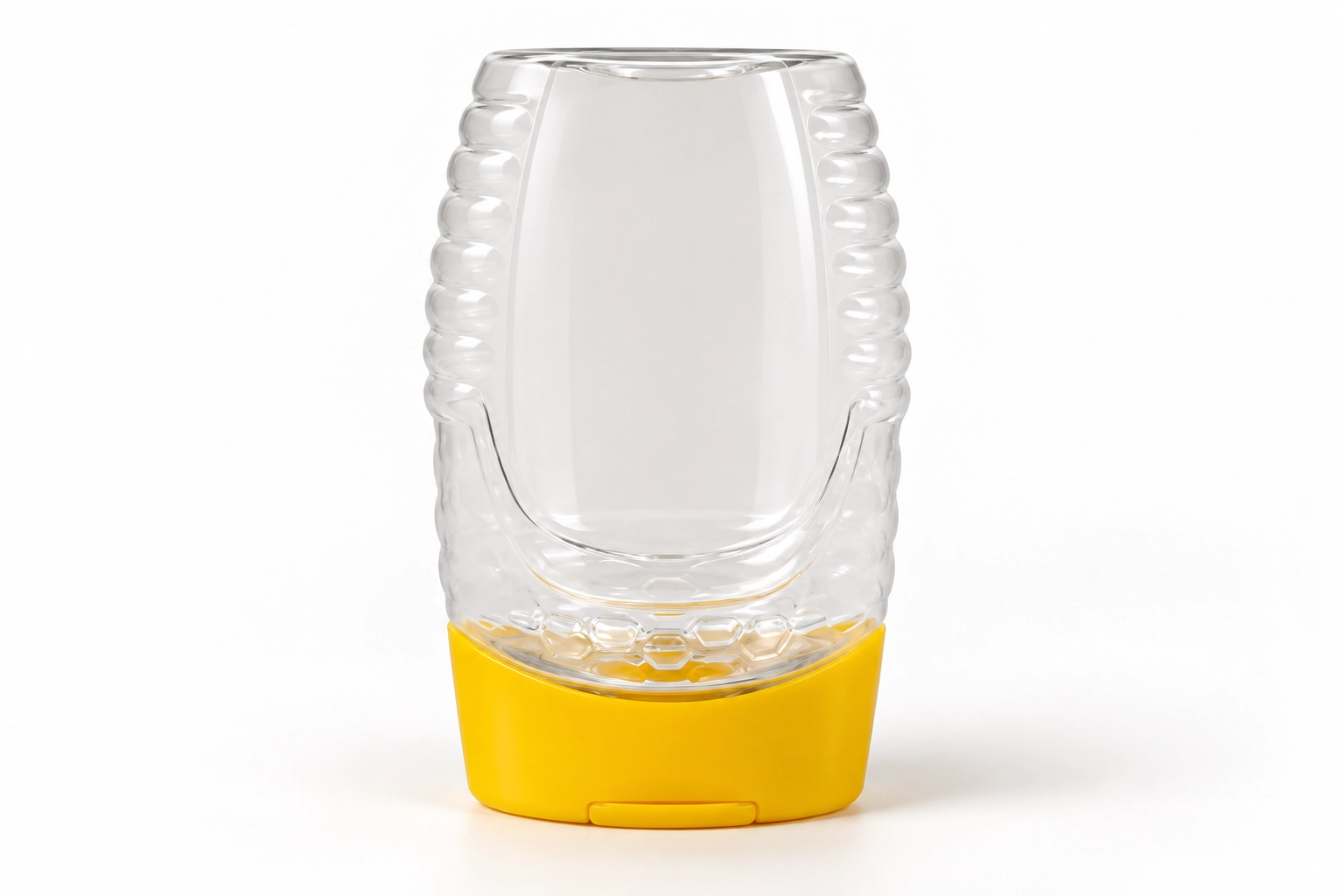
Compact Inverted Honey Bottles
Choose from eight clear PET cap-down honey bottle models in 250–380 ml capacities.
8 options
View specifications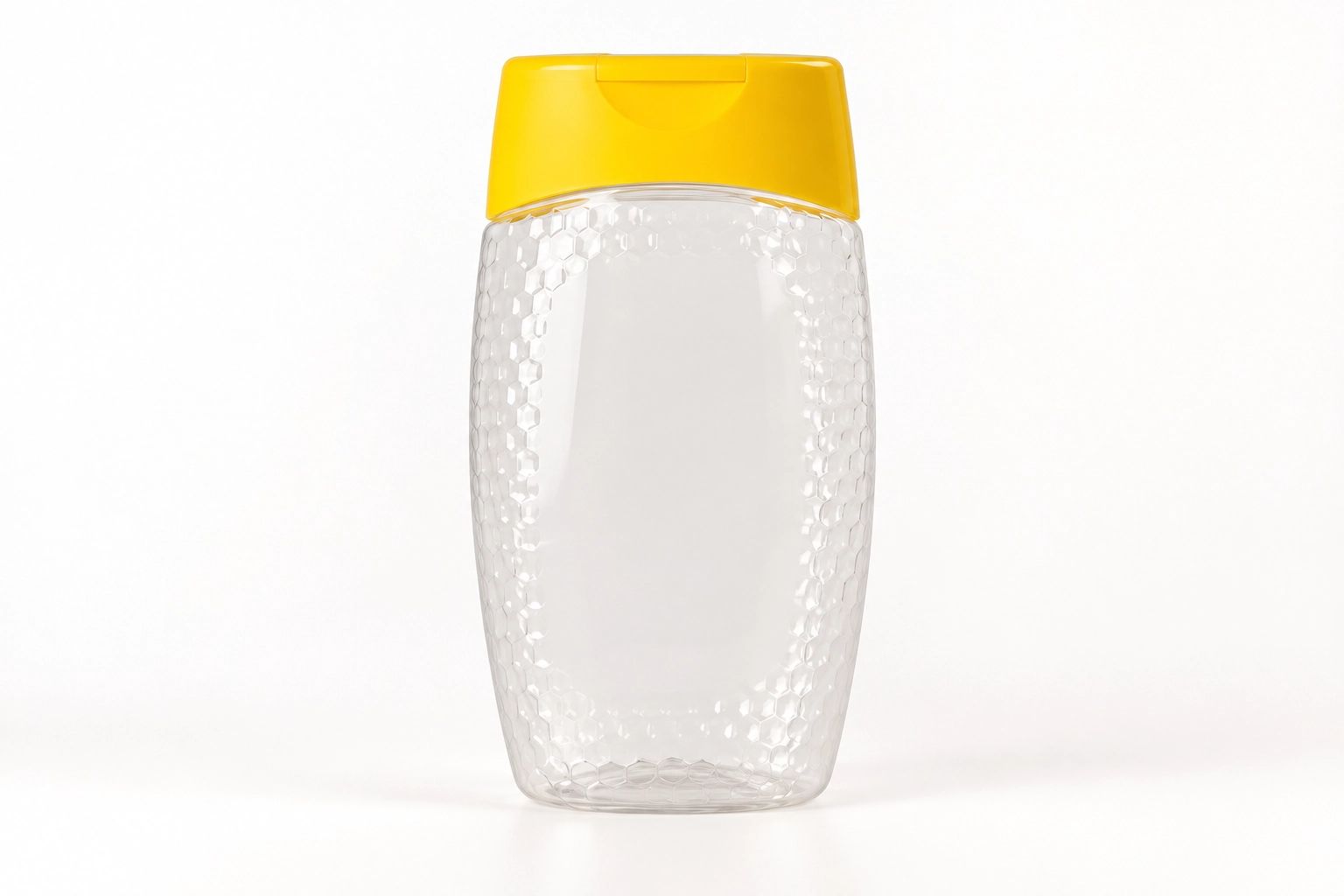
360 ml Oval Inverted Honey Bottle
Model G-12 is a clear 360 ml oval PET bottle developed for cap-down honey dispensing.
1 option
View specifications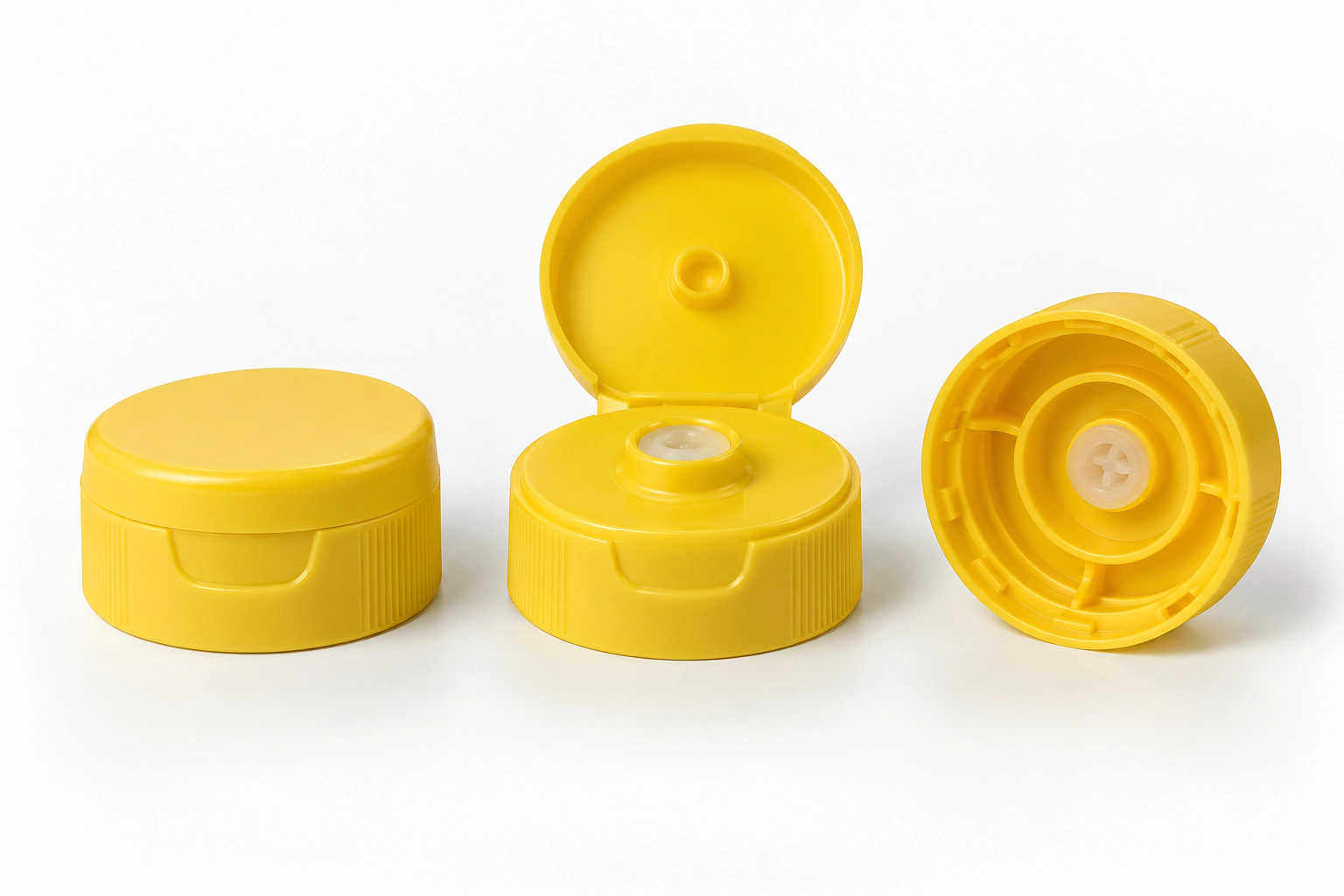
Valve Caps for Inverted Honey Bottles
We supply wide-base PP closures for inverted PET honey bottles, developed for stable cap-down presentation and controlled dispensing.
1 option
View specifications